
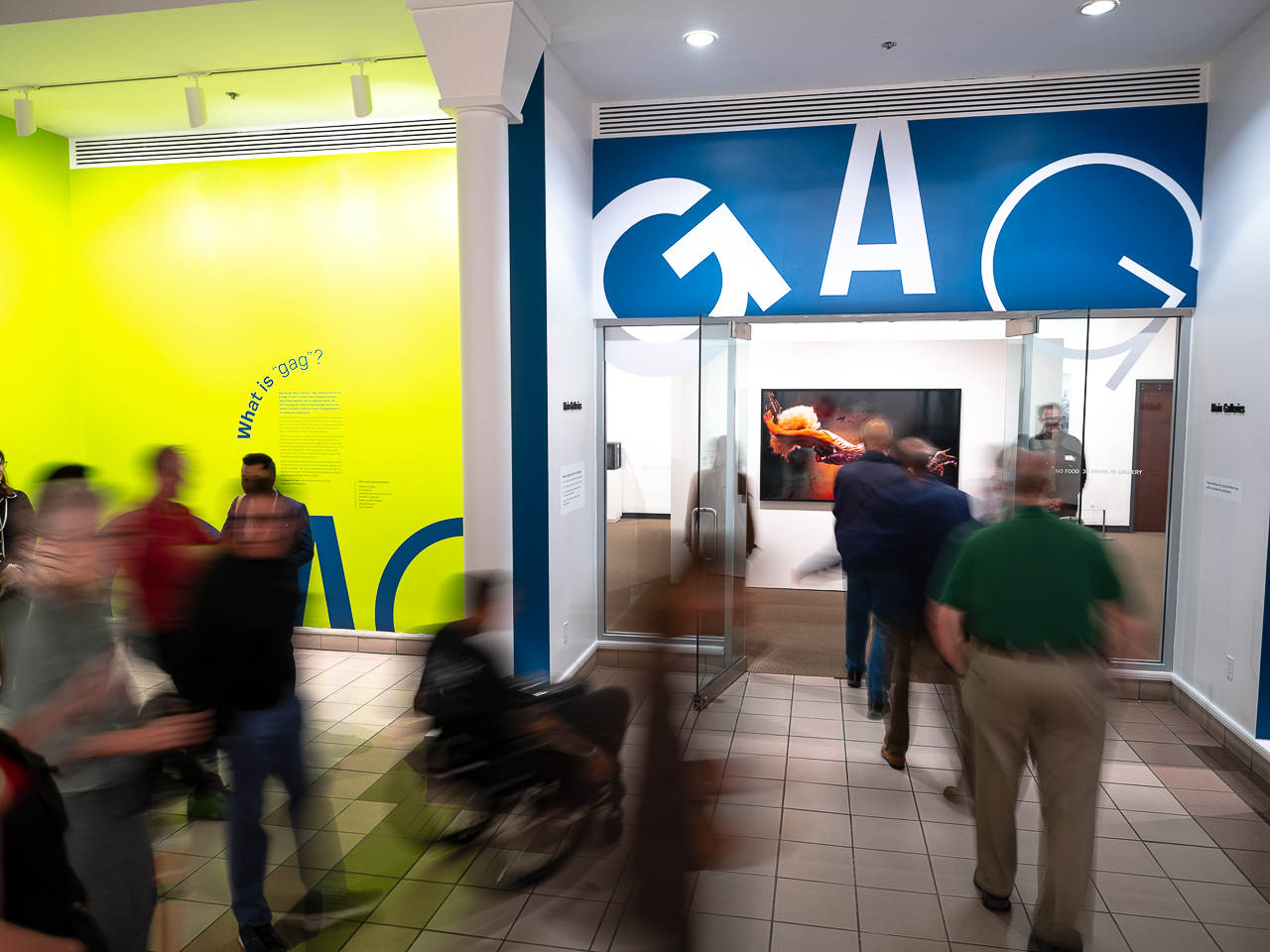
The word “gag” is guttural, visceral, onomatopoeic. Say it, and your tongue hard stops at the back of your throat before releasing air pressure that quickly shuts off in an ugly accent, like a phonetic slice. Like its sound, its meaning shapeshifts. Gags are jokes. But to be gagged is violent.
A menacing word, it carries interpretive weight and multiple meanings in an exhibit, GAG, at the George Eastman Museum. Through images, “gag” becomes a provocative concept for exploring media culture, the constructed nature of images, and structures of power and representation.
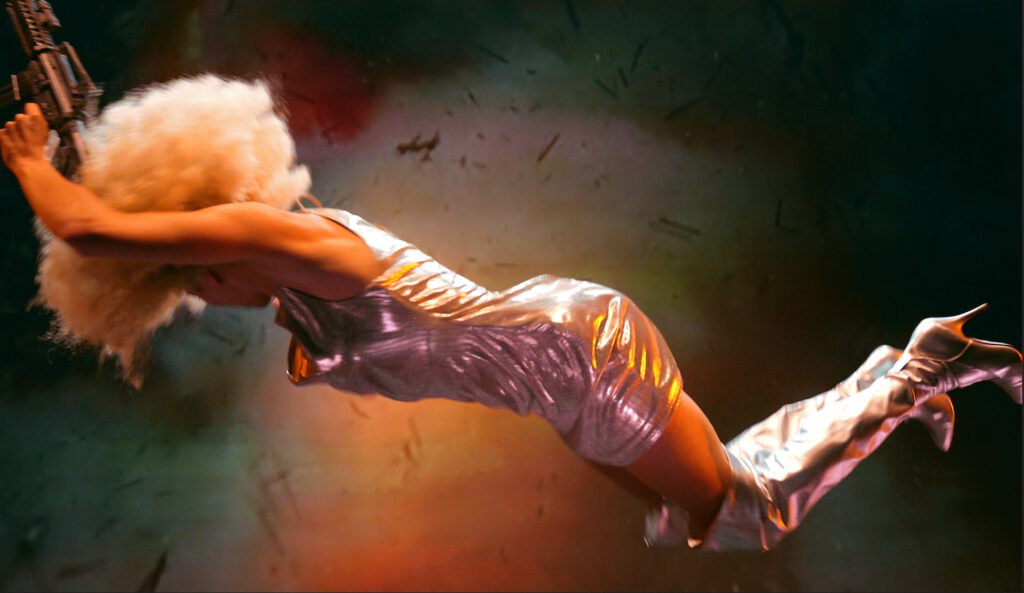
It’s a concept that lands with the first image. As viewers enter the gallery, they are confronted head-on with a Pulp Fiction-esque, film noir image by artist Martine Gutierrez: a woman suspended horizontally, wearing a platinum wig, a metallic foil dress, and shiny knee-high boots. She holds a gun overhead. It’s cinematic, playing on the phrase from filmmaker Jean-Luc Godard, which originated with early silent filmmaker D.W. Griffith, “all you need to make a movie is a girl and a gun.” From the get-go, GAG explores these types of comedic devices that have been hallmarks of film and popular media.
The exhibit begins with such cinematic diversions, and then draws visitors into further deconstructions of the term through its organization. There’s “Service and Submission,” a play on power dynamics, and “Dis/Animations,” exploring how time and motion can play with the sense of reality. Deeper still is “Oral Fixations,” focused on the guttural, sensory experience of gag. And the exhibit ends with “Spectacle, Spectres, Speculation,” where digital images and their manipulations can expose and critique cultural values.
It’s a heady exhibit in meaning that could be alienating if not for the fun and shock value of so many of its images. The term also grasps onto something seasonal right now, if only coincidentally, from the farce and pranks of Halloween to the spooky omens of Friday the 13th. We’re in the season of gags, and the exhibit accords with seasonal uncanniness and will continue to resonate through a barren winter, on display through April 11.
But for all its deeper resonances, the exhibit doesn’t miss that gags can be funny.
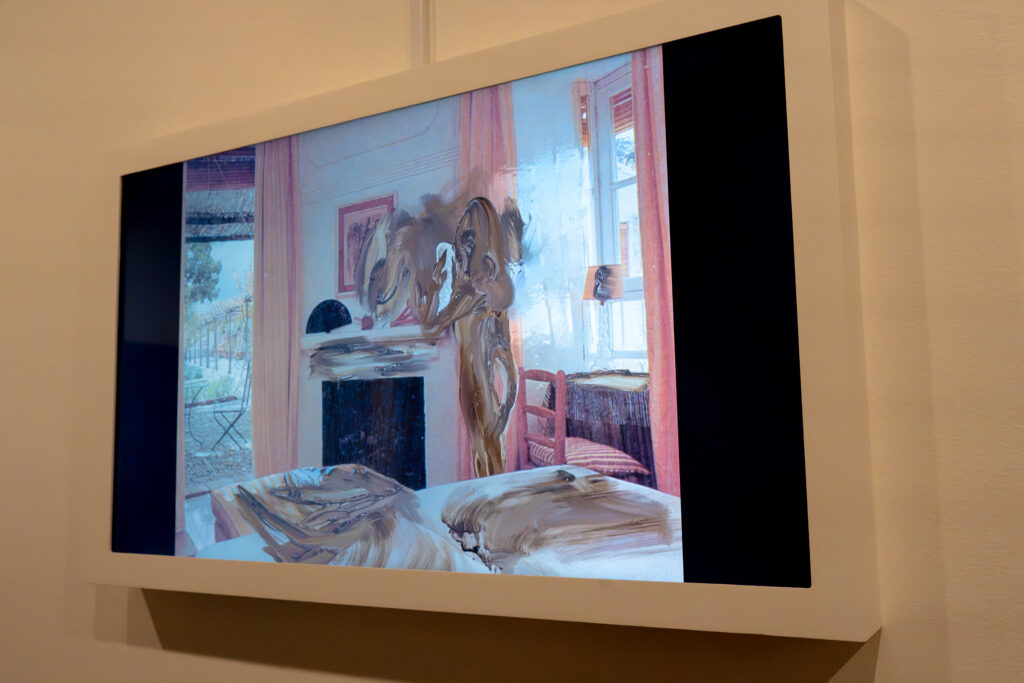
A photograph by Patty Chang shows the artist lying down, propped on her elbows, her lower half obscured except for legs in a mismatched direction that extend over her body, with feet dangling over her head in an impossible contortion. Only on closer inspection is it hilariously disembodied. In Shit Mom Animation 1 by Iranian American artist Tala Madani, an animated video in which a mother made of liquefied brown attempts to relax solo in a far-too-fancy environment and leaves traces of feces on all its elegant surfaces. Nice things are ruined, and attempts at relaxation are thwarted, a humorous take on contemporary motherhood.
Other works are a literal gag. For example, there’s a photograph by Norwegian artist Torbjørn Rødland, Mid Iron (2021), where a golf iron looks shoved down the throat of a woman. It’s clearly a photographic manipulation—for who could be so still and calm with a foreign object jammed down their airway—yet it produces an instinctual feeling of being gagged, stimulating this viewer to reach for her neck in corporeal identification. In a photographic series by Josephine Pryde, slimy mollusks attach to misplaced surfaces in the cramped environment of an airplane lavatory, as if someone set up a gag for unsuspecting travelers while magnifying the ick factor of the enclosed, germy space.
“I wanted ‘gag’ to imply that sense of something that can’t be processed, that lodges in the throat and something that is embodied and felt,” says Eastman Museum Associate Curator Phil Taylor. “There’s a strong affective dimension to the work, and a lot of it is visceral, tactile, kind of icky. And I think there is a sense in which its gag is meant to then evoke a reaction or be concerned with the reaction that something provokes, and the inability to process it.”
Taylor arrived at the concept of “gag” while grappling with how to conceptualize dark humor in contemporary art. While the word might seem frivolous at first, Taylor uncovered an entire conceptual framework in it for analyzing a strain of comedic strangeness in contemporary art that he is advancing as an academic framework as much as a cohesive idea for organizing a photography exhibit.
“‘Gag,’ at some point in this process of thinking about those artists, became the term that seemed to encapsulate both the stumbling block and the humor,” says Taylor. “But I think it also suggests interrupted communication, and we live in a time where there’s such a flood of images of information, the sort of scroll of social media and the screen that, as a form of interruption, gag seemed to suggest a kind of potential for resistance to those ways of engaging with culture and with contemporary life.”
Resistance is a particularly potent idea in the exhibit. Resistance is explored in a series by African American artist Pope.L called Servants, in which he digitally superimposes his own head on nineteenth-century photographs of Black servants caring for white families. Sometimes his head is on top of one of the subjects, as in one where his bearded face, head topped with a baseball cap, replaces that of a young white girl sitting in a posed position next to their Black servant; in other photos it’s an oddity surreally integrated into the background. In all the photos, the artist’s face interrupts the scene and calls attention to racial inequities on display.
In another photograph by Paul Pfeiffer, identifying features of a Black basketball player in a stadium are obscured; only his back, arms raised and hands outstretched, is visible, with an audience cheering ecstatically in the background. The photo comments on the spectacle of race.
And some of the artworks are not images at all, a departure for a photography museum.
One is a sculpture of a man’s disembodied torso, carved from Gmelina wood and painted with religious tattoos. The statue follows the tradition of Philippine artisans who create religious wooden sculptures, a tradition that artist Pfeiffer experienced during a move to the Philippines in his youth. But the subject of the sculpture is well known, and not typically for their pious associations: it’s the pop artist Justin Bieber.
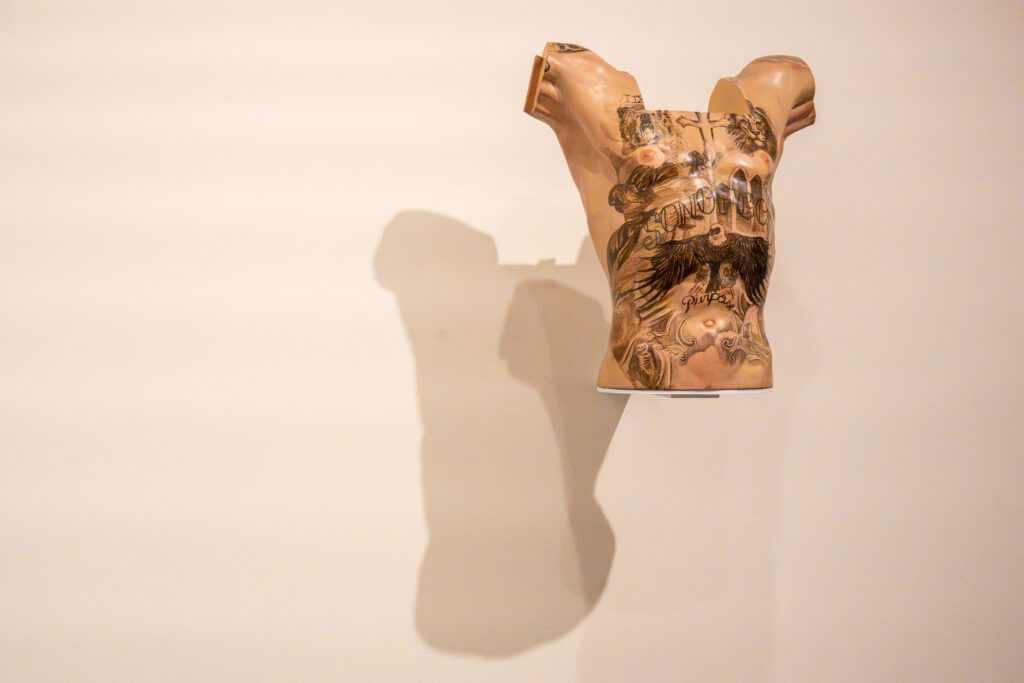
At the time Pfeiffer created the sculpture, Bieber canceled a tour to the Philippines on account of a mental health episode but emerged from it as a born-again Christian. The statue, which resembles an inked Jesus, comments on forms of devotion: religious devotion and that of celebrity culture, and their interesting intersections in Bieber as a subject. Because so much of Bieber’s identity is constructed online, through social media, the artwork also contemplates how images of mass culture circulate. The sculpture earns a place in a photography exhibit for its layered commentary on images.
Lest this exhibit’s overarching conceptual frame and eccentric topic feel foreign to museumgoers, Taylor set up a middle exhibit-within-an-exhibit, finding images in the Eastman Museum’s historical archives that speak to his “gag” theme. Those images demonstrate a concept that can be traced through photographic history and argue for its interpretive range. Taylor hopes, too, that this exhibit continues the museum’s reputation for defining new movements in photography, as the famous New Topographics exhibit did in the 1970s.
To cement the potential of “Gag” as an interpretive lens, Taylor wrote a coordinating book, GAG: The Art of Comic Trouble, which will be published in December. Along with reproductions of the art in the exhibit, the book includes essays from three of the exhibition’s artists—Arnold J. Kemp, Josephine Pryde, and Torbjørn Rødland—as well as a roundtable discussion with artist Lucas Blalock and two cultural historians, Heather Diak and Tina Post. Once published, it will be available in the museum store and online.
Whether a word that is, in meaning and sound, as visceral and wacky as “gag” can be embraced as a new interpretive path in contemporary art remains up for debate. But as an exhibit, the concept succeeds in pulling together art with delightful, provocative contradictions and affective dimensions that are fully entertaining.
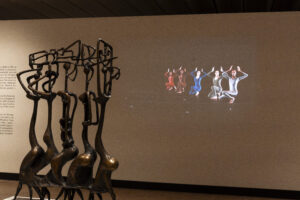
Featured photo: GAG exhibit opening by Erich Camping.
With thanks to Eastman Museum’s curatorial assistant Grace Xiao, who also supported the exhibit.




Be First to Comment