
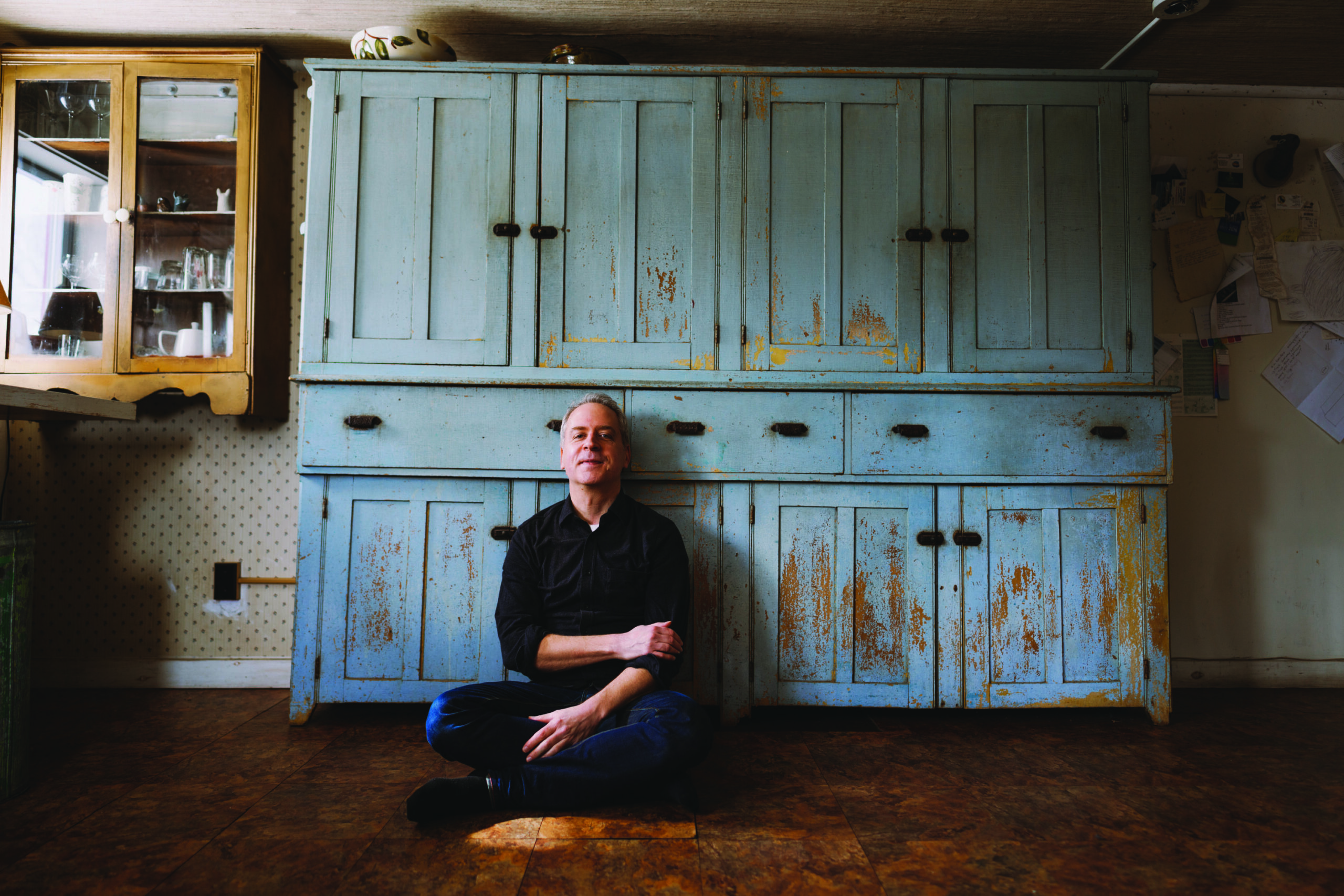
Every few years, pianist Jeremy Denk revives Charles Ives’ Second Piano Sonata, “Concord, Mass., 1840-1860,” known colloquially as the “Concord Sonata.” The 45-minute work is a sprawling journey that gradually traverses from thorny bouts of atonality to serene evocations of nature, each movement based on major figures of transcendentalism, a philosophical movement of individualism, reason, and nature that emerged in New England in the 1800s as America was coming into focus as an independent nation.
“Ives’ music can be a little bit antagonizing, of course, but I do think that it represents some of the most tender and passionate and deeply felt music that has come out of the American classical tradition,” says Denk. “It never grows old for me.”
It’s also a work that helped establish Denk as a singular musical voice capable of taming Ives’ blend of complexity and transcendence and of finding the threads that connect romanticism with modernism and the present day.
After Denk recorded Ives’ sonata in 2010 to great acclaim, which occurred in tandem with his irreverent public writings on his blog, and after, in places like The New Yorker and New York Times, he won a string of major awards: the 2013 MacArthur “Genius” Fellowship, which is an unrestricted $625,000 stipend paid over five years for “enlivening the musical experience for amateurs and aficionados alike through his eloquence with notes and words,” and the coveted Avery Fisher Prize in 2014. In 2016, he was inducted into the American Academy of Arts and Sciences.
Denk brings Ives’ “Concord Sonata” to the Geneva Music Festival on Thursday this week, part of the festival’s 15th anniversary season. The sonata occupies the entire second half of Denk’s recital program; the program’s first half includes other works in Ives’ orbit or that share a similar sense of fearlessness. With works by American composers such as Scott Joplin, Louis Moreau Gottschalk, Nina Simone, and William Bolcom, the Geneva concert does more than help launch us into another Finger Lakes summer; it also helps ring in the upcoming 250th anniversary of the United States.
Ives’ musical voice was an anomaly. A part-time composer and organist, and a successful full-time insurance salesman in Danbury, Conn., he was writing music away from the artistic centers of the late nineteenth and early twentieth centuries. Instead, his sound world included brass bands (his father was a band director), church hymns, and New England patriotic tunes. He was able to combine modernist abstraction with early American popular tunes, using techniques such as polytonality and polyrhythms long before they became significant elements of contemporary music.
The last three movements of the “Concord Sonata,” for example, fold in popular tunes and hymns. Patriotic marches sometimes bombastically cut into the scene. Those popular threads in the “Concord” connect to the other works in the program, which draw on early American musical traditions like ragtime (Joplin and Bolcom) and even minstrel music (Gottschalk’s “The Banjo”). Like Ives, Denk treats these sounds with reverence.
But Denk considers Ives to be foremost a romantic. The “Concord Sonata” is dissonant, he admits, “but it is one of the most romantic sonatas in feeling and structure you can possibly imagine.” The last two movements, he says, remind him of a relative who is “really grumpy, but then they have a heart of gold.”
The last movement is “embarrassingly programmatic,” he says. “Thoreau wakes up at Walden Pond, and then he starts to try to do something, and then he keeps deciding he can’t, and then the rhythm of nature appears to tell him just to relax. And then, and then we hear the train go by, and the bell from Concord Village. Everything happens in the last movement; it’s a very, very literal program. And then, after starting in the morning, we end with night and surrendering, and the surrendering of all works in a certain way.”
He continues, “What could be more beautiful in a natural surrounding like Geneva, because that piece more or less ends with a prayer to nature, and to the pond, the Walden Pond, and the sense of everything hovering in the midst above us. It’s an incredibly nature-oriented piece.”
Additionally, for the concert, Denk performs two Beethoven sonatas, opus 90 and 110. Those works connect with the “Concord Sonata” because not only was Ives deeply invested in Beethoven’s music, but the “Concord Sonata” also contains literal references to Beethoven. Out of the surges of strange dissonance that start off the first movement, vaguely familiar notes are thrust out of the texture: the iconic motif of Beethoven’s Fifth Symphony, short-short-short-long. The motive is folded into all four movements of the sonata, a recurrent thread of Beethoven in a work that, at least in harmony, couldn’t be more different.
Denk explains, “Ives worshipped Beethoven as a fellow seeker of truth. I guess he found him to be a very philosophical and uncompromising composer and always questing after the new. So there’s a lot of Beethoven woven into the ‘Concord Sonata,’ literally quoted, and there’s a lot of the idea of Beethoven, the sort of vast ambitions of Beethoven and the philosophical qualities of Beethoven, and the wildness, the juxtaposition of the sublime and the ridiculous.”
When asked if Beethoven, who bridged the Classical and Romantic eras, might, in some respects, be considered an early transcendentalist, Denk agrees, citing Beethoven’s interest in overarching unity—exemplary in Beethoven’s Opus 110—and an interest in the philosophy of the period. “Beethoven did believe in a musical over-soul”—a connecting, universal spirit, coined in transcendentalism—“and was trying to find philosophical solutions to some of the conundrums that haunted him his whole life.”
The two composers shared more than just philosophy: they were also cantankerous personalities, something Denk attributes to their waning health. Beethoven not only struggled with hearing loss but also had debilitating gastrointestinal issues; Ives was plagued by diabetes before modern medicine could help manage it. “They were complicated and difficult in their letters and personal lives,” says Denk, “and yet fearless and super idealistic in their musical lives.”
Denk isn’t as irascible in his writings, but he is known for bringing a philosophical outlook to both his playing and his writings. His memoir, Every Good Boy Does Fine: A Love Story in Music Lessons, published in 2022, explores learning to play music at a professional level and honors the mentors who shaped him along the way. It was an extension of a piece he wrote for The New Yorker in 2013 that went viral. “Piano lessons are very boring,” he tried to tell his publisher, initially struggling to find the book’s through-line. But he eventually focused on the human interactions and affecting moments from his lessons over the years, realizing the book was ultimately “about the kind of vulnerable and emotional transactions that go on in lessons.”
Next up for Denk is a recording of etudes by contemporary women, including works by Missy Mazzoli, Hélène de Montgeroult, “who’s a great discovery I made this year,” and Unsuk Chin. He is also planning to write his second book, which he says is “about Beethoven, kind of…” He says it’s a comedy that’s trying to cope with late Beethoven in modern times. “If it’s going to be the book that I think it is, it’s going to be very naughty.”
—
The Geneva Music Festival is a four-week festival celebrating its 15th anniversary, featuring resident artists, local composer showcases, and renowned guest artists – all celebrating America’s 250th anniversary this season. Here are the remaining concerts by the guest artists, which span classical, jazz, contemporary music, and Americana. For the rest of the season and tickets, visit the Geneva Music Festival’s website.
Jeremy Denk
Thursday, May 21
7:30 p.m. | Gearan Center for the Performing Arts – Froelich Hall, Hobert and William Smith Colleges
Fred Hersch Trio
Saturday, May 30
7:30 p.m. | Gearan Center for the Performing Arts – Froelich Hall, Hobert and William Smith Colleges
Eighth Blackbird
Thursday, June 11
7:30 p.m. | Gearan Center for the Performing Arts – Froelich Hall, Hobert and William Smith Colleges
Mark & Maggie O’Connor
Sunday, June 14
4 p.m. | Geneva on the Lake
Photo: Josh Goleman


Be First to Comment