
Animating the Nazareth University Arts Center stage last week were rotating limbs, grounded grooves and off-kilter poses. It was the recognizable movement vocabulary of Garth Fagan Dance, which, with four performances from Thursday through Sunday, celebrated the end of its 55th season. But not all those movements were created by the company’s auteur, Garth Fagan, who stepped down nearly three years ago and is now 86. The first half of the concert revived seminal Fagan works from the ‘80s, now set on a crop of young dancers who have joined over the last four to five years. It was the second half of the concert that featured recent and new works by his protégés, Norwood ‘PJ’ Pennewell and Natalie Rogers-Cropper, two dancers long steeped in the Fagan technique who have been tasked with the company’s continuity and progression.
Rarely does a concert end without a Fagan classic, but the concert format, in addition to the balanced scale of new works, seemed to communicate something about the company’s evolution, despite the continued feting of its founder, who was in attendance on Thursday’s opening concert. The choreographers seemed to be grappling with indebtedness to Fagan’s concepts and movements, whether consciously or not. Should their choreography extend the lineage or succeed it?
Both Pennewell and Rogers-Cropper’s identities have been fused with Fagan’s aesthetic for decades. Pennewell joined the company in 1978, only eight years after Fagan founded his “Bottom of the Bucket BUT… Dance Theatre,” the company’s original name. Rogers-Cropper, a Juilliard-trained dancer from Trinidad, was recruited for the company in 1989. Both dancers are among Fagan’s most quintessential talents and received prestigious New York Dance and Performance Awards, better known as the “Bessie” Awards, for their disciplined, masterful performances. For decades, they were muses for Fagan’s visions. When Fagan stepped down in 2023, Pennewell rose to the company’s artistic director and Rogers-Cropper was named its executive director.
Pennewell isn’t a new choreographer. He may have only taken over the company’s artistic direction three seasons back, tasked with keeping Fagan’s aesthetic intact, but he has slowly developed an artistic voice since he began choreographing for the company in 2010. How much individualism he can impose on the company has always been a question mark. Fagan has always loomed as the king of his dancers’ savannah for his singular vision in fusing modern and Afro-Caribbean movement, and for his fame as the Tony-winning choreographer of The Lion King on Broadway. The syntax of Pennewell’s choreography can easily pass for Fagan’s, but its significance has shifted from Fagan-style resistance towards more quiet reverence.
In his 13th work for the company, Pennewell’s “Priestess Hill” (which premiered in collaboration with the Rochester Philharmonic Orchestra in January) demonstrated that reverence on Thursday night. To a repetitious and oddly metered samba that gradually ratcheted up in intensity by composer Philip Glass, Pennewell’s work opened with soloist Kiara Jolié Haywood, who commanded the stage, embodying the Fagan archetype. She loosely swung her arms and swayed her body in smooth undulations yet halted in impossible holds without warning—all part of Fagan’s lexicon. But even when the rest of the company joined in, dressed in bright Jamaican colors, there weren’t the discontinuities that we’re used to seeing from Fagan, which usually carried social critiques. Rather, “Priestess Hill” seemed more organically expressive and drew on Glass’s cyclical score in how the movement vocabulary was repeated and layered.
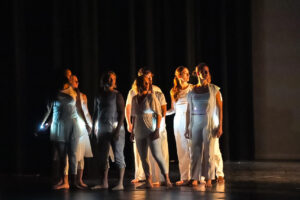
The night ended with Rogers-Cropper’s second creation for the company, the world premiere of her “Messages to the Storm,” which is based on poems by Maya Angelou. Her work—and movement—verged on something more contemporary, as a tangle of dancers morphed around the stage, illuminated by a dark blue background, to Bobby McFerrin’s scatting. Two female dancers in a duet anchored the work’s middle—Daria Clarke, who might have been the company’s most senior dancer on the concert’s stage, having joined the company in 2021, with the newer Raea Moorehead, who joined in 2024—and they were then consumed by the group of dancers in the work’s third and final section. While Rogers-Cropper’s work was also, in many ways, steeped in Faganisms (including same-sex pairing), there was something less traditionally abstract and more progressive about the concept, staging, and even musical choices, offering a glimpse of how the company might remain vital rather than merely historic.
The concert opened with “Prelude (Discipline is Freedom),” a vintage Fagan work from the early 1980s that has featured on many of Fagan’s concerts. Designed as a studio warm-up (and doubling as a warm-up for the concert), the work explores gender relations and social constructions. It also highlights the dancers’ personalities, particularly in the second section, where each dancer gets a solo moment in across-the-floor progressions with flying leaps and intricately positioned arms and steps that create a whirl of movement, offering a chance to glimpse each dancer’s individual virtuosity. With the company’s turnover over the last handful of years, this gave long-time Fagan fans the opportunity to see how the newcomers are adapting to Fagan’s technique and discipline, and a window into their developing identities within the company.
For the final Fagan work on the concert, the company also revived another 1980s work, “Never Top 40 (Jukebox)” which premiered in 1985 as part of a USIA-sponsored tour to Africa. This was its first restaging since the 1990s. As per the title, the movements feature a jukebox of musical selections, ranging from opera to jazz to musical psalm settings—a Fagan-curated “top 40,” meant to contrast with the uninspired pop radio “top 40.” It is also a jukebox of Fagan’s aesthetic, from his methodological modern movement to more jubilant African dancing. The work was also nostalgic: it was one of the first pieces in which Pennewell and Rogers-Cropper danced together in the ‘80s. The performance demonstrated their reverence for the work.
Rochester audiences have another chance to see Pennewell’s choreography and the company in action through August: Pennewell and the company were tapped to create short dances inspired by African American artist John Rhoden’s sculptures, which were filmed by Floating Home Films and are on view in a retrospective exhibit called “Determined to Be” at the Memorial Art Gallery.
If Fagan’s aesthetic could be captured in static figures, it would probably look a lot like Rhoden’s creations. Rhoden’s figures juxtapose round suppleness with angular geometry, a complement to Pennewell’s Fagan-steeped appositions of fluidity and rhythmic edginess. Pennewell responded to five of Rhoden’s works with choreography, adding a fascinating dimension to the artworks on view.
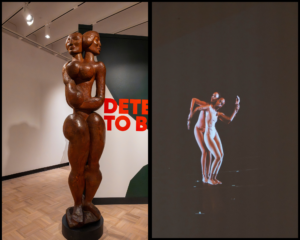
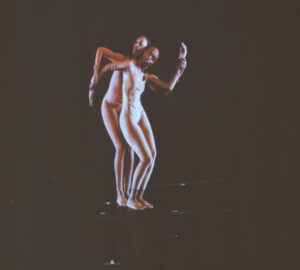
The first work captures attention as soon as one steps into the gallery. Next to the overview of Rhoden’s life and work stands a larger-than-life teakwood sculpture, “Generations” (1963), depicting two women in a close embrace to represent their familial, generational connection. Like conjoined twins, they share a single body, with supple, rounded bosoms and buttocks, and two heads facing in opposite directions. Pennewell’s choreography features two female dancers, one tall, one shorter, both in neutral leotards, who find moments of recognition in opposing poses before they embrace. The video of the dancers is as if the sculpture was suddenly unmoored.
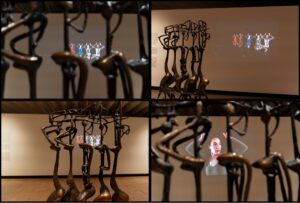
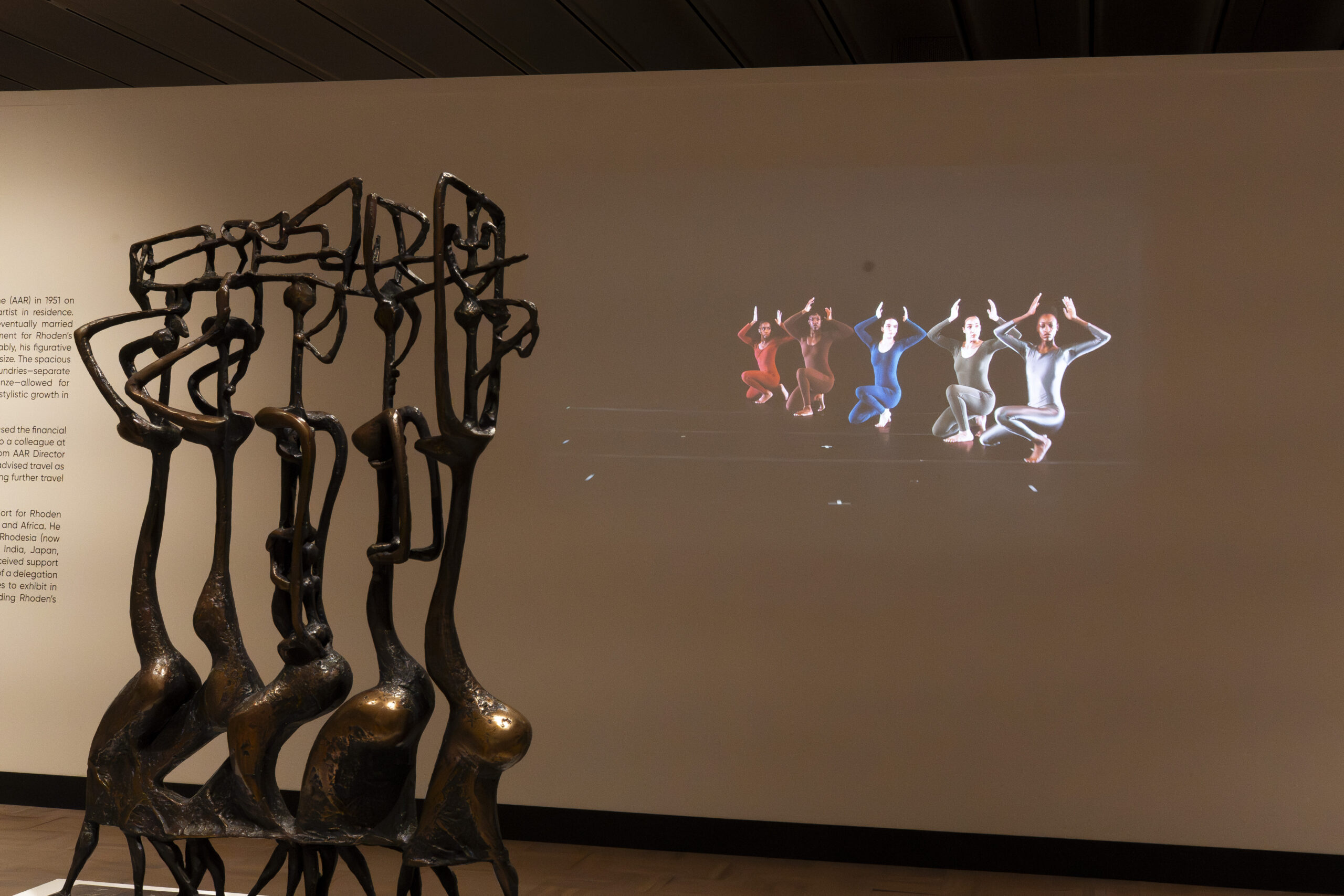
In “Safari” (1958), a sculpture of connected African female figures is abstracted through thin, extended torsos and arms in the air, carrying what seems like a wired, interconnected heap overhead. A couple of figures have children hanging on their torsos. The torsos and arms are spindly, curvilinear. The bottoms of the women are more curved and ample. The accompanying video features five of the Fagan company’s female members, each in a full-bodied, unicolored unitard, each in a varied color (red, maroon, blue, green, silver), moving as a unit in ever-changing formations and holds, with elbow-bent arms held overhead, like the sculpture.
In all selections, Pennewell takes influence from the poses and colors of the sculptures, featuring mostly smaller cohorts or soloists that correspond to the number of figures in the sculptures. The exhibit is on display in the Docent Gallery through August 23rd and is particularly complementary in its multimodal presentation.



Be First to Comment