
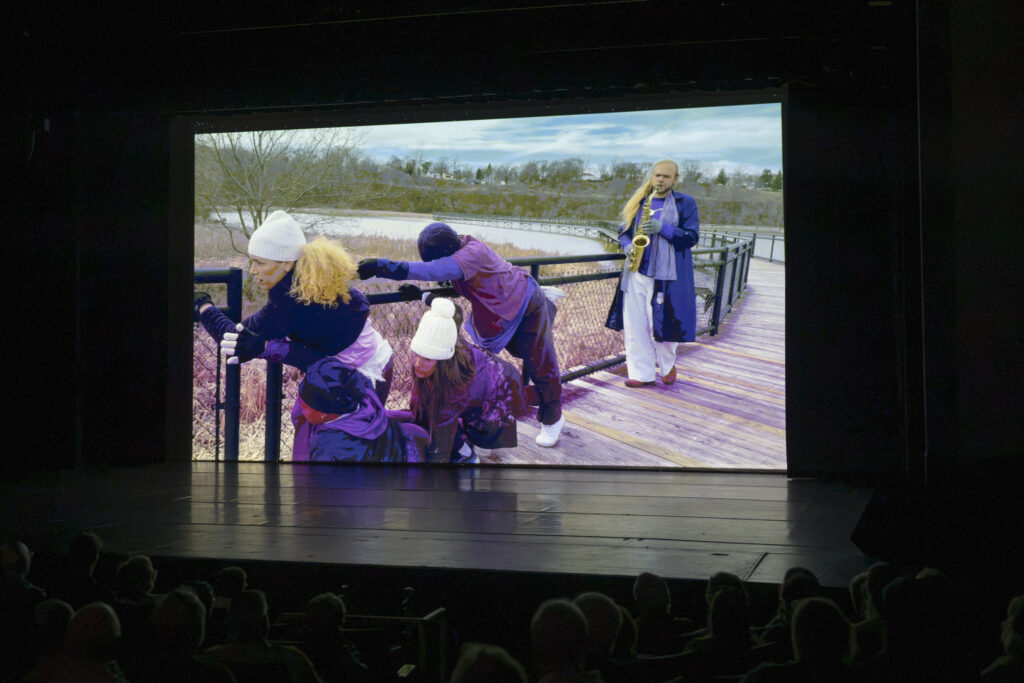
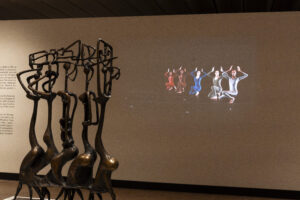
On Wednesday night at the School of the Arts, Artistic Director and choreographer Missy Pfohl Smith prefaced BIODANCE’s opening number, Boiling Point, by warning that it’s a grim, odd opening. It was not danced on stage. Instead, it is a site-specific work that was filmed at Turning Point Park in Charlotte. The film showing opened the company’s twentieth anniversary performance, part of the ESL Rochester Fringe Festival. With scenes spread across a circular concrete pier littered with graffiti, a wooden bridge with a chain fence, and stark winter fields, four dancers huddled, leaned on, and fell off each other, wearing hats and scarves over street clothes in matching and changing color palettes. Gruff saxophone noodles and screeches accompanied the dancers, with a saxophonist eventually revealed on the screen at the park (Floris Van der Veken, a doctoral student at the Eastman School of Music, who composed the soundscape). By the end of the work, the music rose to high-pitched effects, like flying insects, over a glassy drone. The music, movement, and scenes were infused with a sense of environmental uncertainty, of the changing climate and its impact on humans.
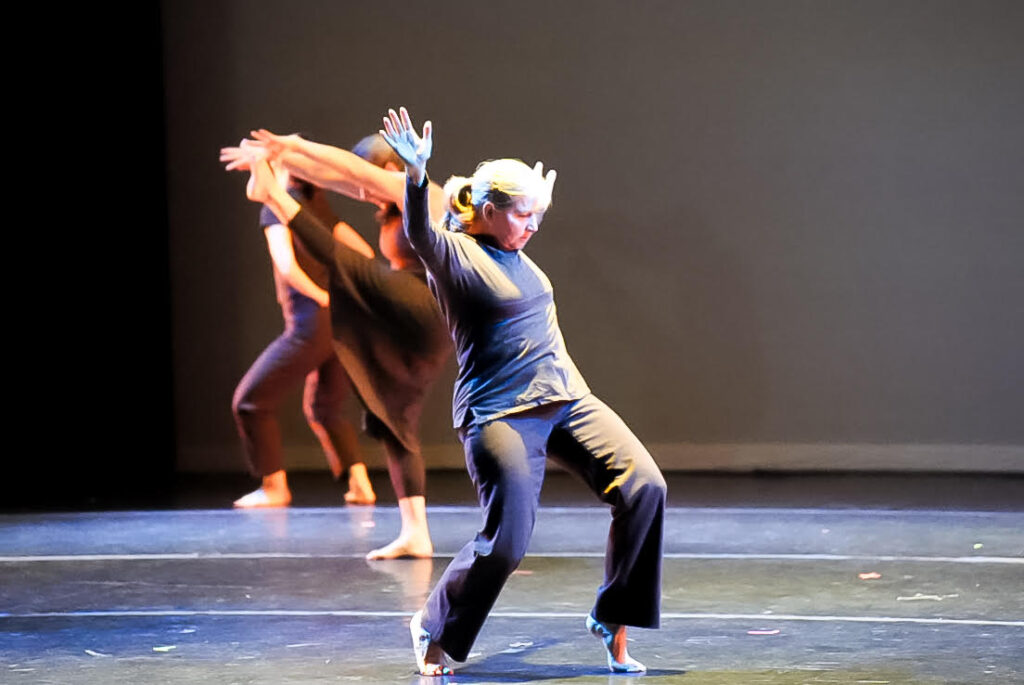
No apologies were needed for the opening. That’s the kind of socially engaged art that BIODANCE has been known for over its last twenty years. Video vignettes of Pfohl Smith and other dancers between works reflected on the company’s twenty years of pursuing realness and humanity, and on the dancers’ connection to each other and to its artistic director, Pfohl Smith.
Like Boiling Point, some works on Wednesday’s program directly commented on current issues. That included “Guzzle!”, a revival of a 2008 work by Pfohl Smith with video by the company’s longtime collaborator W. Michelle Harris for BIODANCE, originally about ‘Big Oil’ but, she explained, expanded to include mass consumption writ large. The work begins with a group of dancers, two bent over with their backs like tabletops, as the group eventually starts grabbing invisible food off the table and stuffing it into their mouths, the music turning cartoonish. Then the scene shifts into a game-show race between oil companies, portrayed by dancers with white coats who zoomed around the stage. (Spoiler: Exxon Mobil wins.) All the while, news headlines about oil companies and pulled statistics appear on the background screen. It ends with dancers pulling black oil (presumably paint) out of glass goblets and painting each other’s faces with it. Subtle, it was not.
In another work, Pfohl Smith’s Le Cygne, set to “The Swan” from Camille Saint-Saëns’ Carnival of the Animals, a dancer kneels and rounds over, their shoulders performing waves of movement to mimic a swan’s wings. But a leg would jerk, and then the shoulders would pop and stop—movements that suggested environmental forces seizing up the swan’s graceful movements. The 2024 work was originally a collaboration with the Seneca Park Zoo.
Other works were more about the difficulties or joys of human connection. Second on the program was We are no longer here, we are no longer sure, choreographed by Ripp Greatbatch, a London-based choreographer currently teaching at the University of Rochester. In it, two female dancers in ordinary clothes move almost like shadows before brief moments of conflict, followed by bids for physical connection, of handholding and embracing. As soon as one pulls away, the other moves to repair. In That’s All, Folks! from 2017, two dancers—Pfohl Smith and Jean Michael Rubingu—move with happy familiarity to a background of voices talking about human pleasures like food, family, crushes, and stargazing. The audience was instructed to close their eyes and open them, as if to catch snapshots of life to savor and commit to memory before their eyes closed again.
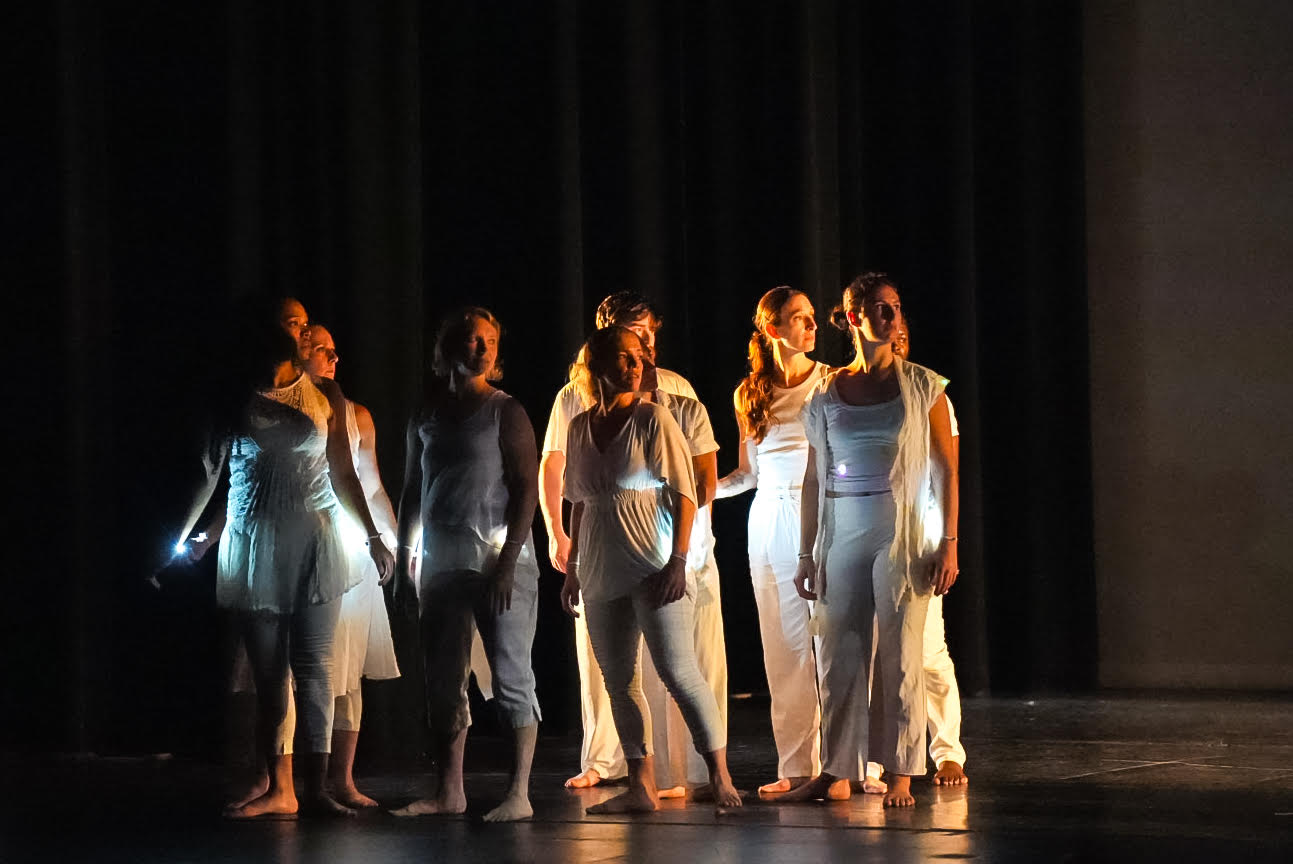
The concert ended with an excerpt from Anomaly (2013), a work in the dark, where dancers in sheer white outfits and lights affixed to their wrists moved and morphed down the audience aisles, eventually reaching the stage, with the choreography grouping dancers before they came together at the end. Set to Arvo Pärt’s Spiegel im Spiegel, it was visually stunning; the shadows cast by the light created a mystical atmosphere where time felt suspended. Whether the last work was a commentary on electricity, or something else, or nothing at all, it didn’t matter. In it, and throughout BIODANCE’s concert, was a sense of making human connection visible, palpable, and viable.
The concert repeats on Thursday, September 24 at 8 p.m. at the School of the Arts’ Allen Main Stage Theatre.
Featured Photo: Anomaly (2013) at Fringe. Photo by Anna Reguero.
Rochester Overture will be covering the Rochester Fringe Festival throughout its 12-day run, with reviews, photography, and more. Follow all of our Fringe coverage at rochesteroverture.com/fringe. Follow our socials on Facebook, Instagram, and X.
Arts journalism informs, documents, contextualizes, historicizes, questions, and amplifies the arts. Rochester has a rich arts legacy and an arts community producing significant creative work—and it deserves serious coverage that treats the arts as a major civic beat. Rochester Overture exists to fill a critical gap in Rochester’s arts ecosystem. Please consider supporting the publication.


Be First to Comment