
Audiences turned mannequins and comedic stories of public excretion were among the experiences at Rochester Fringe this week. Read more about what’s on tap at Rochester Fringe in its final days.
Spectatorship on View: Window Scrolling at Rochester Fringe
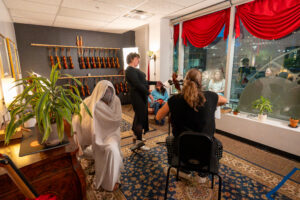
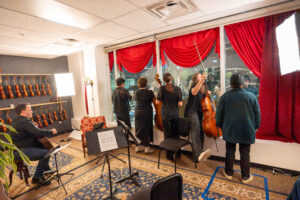
A singer opens their mouth as if projecting a phrase, gesturing with their body and hands, while another performer hunches over a cello, drawing the bow with precision across the strings. They’re engaged in a performance. But the sound is only faintly audible.
A barefoot dancer in a white sheet and facemask shifts and crawls around the performers, gesturing to the sounds heard inside. A corporeal evocation of sound, the dancer makes visible what the ear cannot hear.
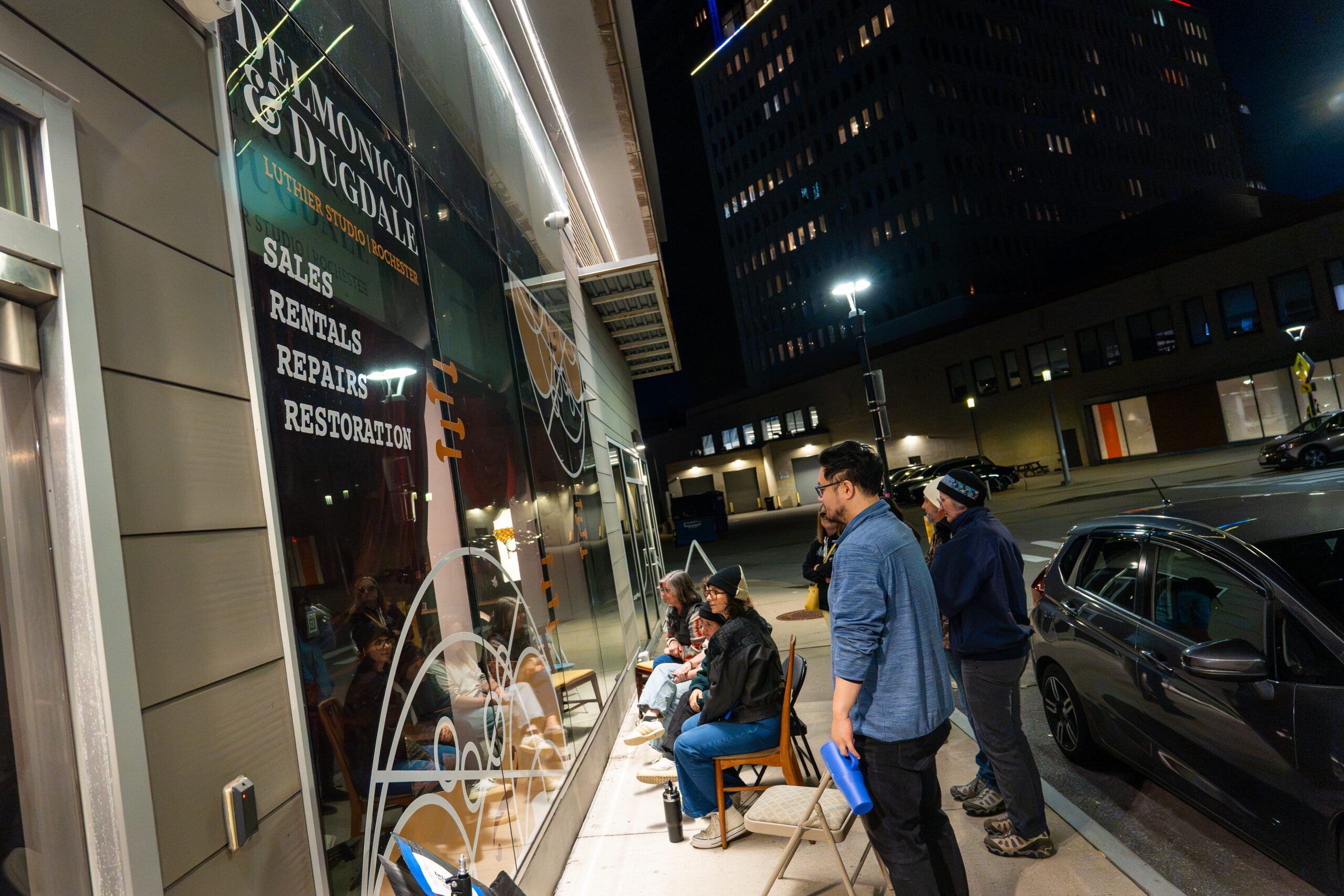
That was a scene viewed through storefront glass from the sidewalk in front of Delmonico & Dugdale Strings, visible from Atlas Street in downtown Rochester. It was a performance called Window Strolling, part of the ESL Rochester Fringe Festival. Cellist Esther Rogers Baker organized the event, bringing together local musicians and a dancer for the concert in collaboration with the string instrument store.
The store’s glass barrier posed a question: What does it mean when sound is visible but not heard? The format emphasized that musical performances are more than just a series of sounds. By isolating the performative side of music-making, the event revealed the concert as a multi-sensory, theatrical experience.
But that was not all. Because classical music is often an insider art form, the separation between performers and audiences could read as a commentary on the art form’s notorious exclusivity. At the same time, literally anyone could walk by and engage. A dog walker, a unicyclist, passersby from the nearby Parcel 5—all found intrigue in the actions happening inside the small store.
However, in a reversal of spectatorship, those watchers also became part of the scene. The group sitting and standing on the sidewalk, viewing something closed off from them, became its own curious happening. To emphasize this, the performers at one point took chairs and sat up to the glass from the inside, staring back at the outside audience as if they were the ones on display.
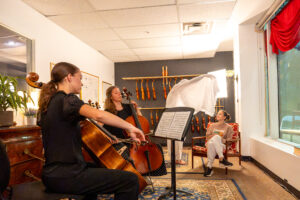
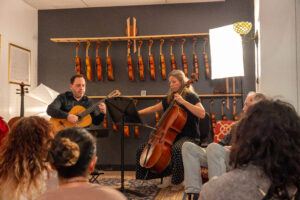
Audiences were also invited inside the store, into a warm performance space that felt like a cross between an antique living room and a string instrument showroom. The well-lit space featured antique couches and chairs, oriental rugs, and vintage-looking stringed instruments lining the floor and hanging on the far wall, sometimes draped with red cloth.
Crossing inside was like stripping off an aural mask; ears newly filled with the sounds it longed to hear when outside.
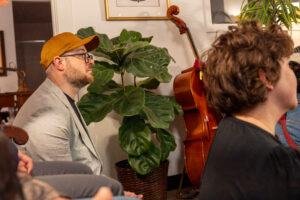
But the musicians did not play for those inside; they played for and to the audience outside. And to be inside was to agree to participate: at all times, at least one person inside was required to stand in a space boxed off by blue painter’s tape to act as a storefront mannequin. The audience, then, was bifurcated, but in the starring role, staring back at each other and watching from across the glass.
Many of the musical choices were contemporary, with angularities, stark gestures, and contrasts that emphasized the performative nature of the event. But even the more traditionally classical selections found curious dimensions in the unusual performance format.
To end, however, the performers broke the concert’s premise: they invited everyone inside to gather around, on chairs and on the floor, to enjoy the peacefulness of Arvo Pärt’s Spiegel im Spiegel, a hauntingly beautiful cello melody played by Baker and accompanied by guitarist Michael Hardy. At last, the distance between performers and audiences disappeared, and everyone melted into the night’s final sounds.
Window Scrolling repeats on Saturday at 7 p.m. at Delmonico & Dugdale Strings (88 Elm St Ste 102). This is a free event; tickets are not required.
—Anna Reguero
See a gallery of the show:
Laughing Through Embarrassment and Despair: Martin Dockery’s Wanderlust at Rochester Fringe
New York- based performer Martin Dockery is not just a storyteller. He is a vivid, energetic raconteur with an almost cinematic perspective, referencing special pens from the New York Stock Exchange and neon mango expectorate against a backdrop of lost love, mistaken identity, and projectile vomiting. It takes an adept artist to weave all these disparate subjects into a compelling hour.
When I first entered the SOTA Ensemble Theatre, I wasn’t sure how Dockery would make an entrance. Would there be a formal introduction? Would Dockery enter the stage with an anthem of some 90s grunge music blaring with lights ablaze?
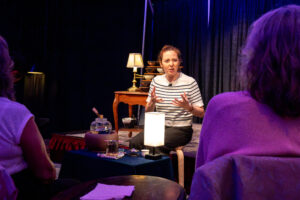
Instead, Dockery came out as if we were in his backyard, greeting us quite warmly. I thought for a moment I would be offered a drink and be asked how my week was going. Then Dockery says his much-loved godmother is in the audience, and the audience cheers. I knew this would be an intimate performance.
Dockery immediately launches into the first of four chapters of his saga: his five-month journey to West Africa during his mid-thirties. Dockery initially describes his life at a temp job in New York City as if it were a scene from the film Office Space, a dull office drudgery with no joie de vivre. Dockery says he decided to travel to Africa after a painful breakup to discover himself.
He continues to share the details of his travels, describing quite passionately every neurosis he experiences along the way. From fighting scorpions to people pretending to be a family to Dockery’s tour guide to an 18-year-old man letting him stay in his house after Dockery has a bout of explosive diarrhea and vomit in public. We see and feel Dockery’s moments of embarrassment and despair through a hilarious lens. He is self-effacing but completely aware of the comedy of his circumstances. When Dockery states that the 18-year-old man is a rapper and writes his own rap songs, Dockery shares with the man and us that he is a master beatboxer. The tale of Dockery beatboxing to a French-speaking African family only hours after horrifically vomiting and pooping in front of a massive crowd is an indelible one.
Dockery also evokes tenderness and wistfulness when describing his ex-girlfriend and his attempts to communicate with her after she has moved on. The break-up is clearly an unexpected and sad hurdle in Dockery’s journey of self-exploration. However, Dockery narrates the details with insight. We feel the shame he experienced through his break-up and his own introspection of his hubris throughout the relationship.
Dockery is an enjoyable, relatable performer who enchants us with his personal tales of self-discovery. He has a tremendous talent for transporting his audience into his life with warmth and genuine humor.
There are two more showings of Martin Dockery: Wanderlust at the ESL Rochester Fringe Festival: Friday, September 25 at 7:00 p.m. and Saturday, September 26 at 3:00 p.m., at the Ensemble Theatre at the School of the Arts.
—Sudha Brightman



Be First to Comment