
Friday night’s ESL Rochester Fringe Festival featured an improvised horror comedy and a one-man vaudeville act. Here’s what we saw:
Cheeky Humor and Grotesque Terror as Improv: Misery Loves Company
In the 1990 film version of Stephen King’s novel Misery, the dynamic between novelist Paul Sheldon and nurse/psychopath Annie Wilkes constantly shifts between cheeky humor and grotesque terror. We laugh and shake with fear at the same time. The late Rob Reiner did an outstanding job dancing the line between horror and comedy, creating one of the most beloved films of his career. James Caan and Kathy Bates became icons based on their performances, and Misery remains one of the scariest and funniest films ever made.
I remember seeing Misery as a teenager and being nonplussed by its tone; was it OK to laugh at the hyperbole of Annie’s behavior while also being sickened by her debauchery? Was it appropriate to root for Paul’s comeuppance as he escapes Annie’s clutches while also feeling sympathy for Annie’s unrequited obsession with Paul? Such complexity for a “horror” film!
Therefore, how does one translate a film of such esteem and nuance into an hour-long improv comedy performance? Welcome to Misery Loves Company.
Misery Loves Company is an improvised horror comedy featuring Second City alums Joe Liss and Dee Ryan as Paul and Annie, respectively. The performance starts with the traditional improv format: Liss and Ryan ask the audience for suggestions for an exciting or highly regarded profession, a less interesting profession, and an important heirloom. The audience suggested “gynecologist, secretary, and grandfather clock.” Suddenly, the story of Misery mutated into a bizarre, unpredictable, and hilarious interpretation of King’s book and Reiner’s film adaptation.
Liss made Paul into a pervy OB-GYN tech guru with a British accent who creates AI vaginas and discusses female anatomy with such bravado that Liss designates himself the future of mutant female genitalia. Ryan transforms Annie from just a stereotypical psychopath into a warped feminist, defending women against Liss’s misogynistic technology with just some “minor” sadistic tendencies, like breaking Paul’s ankles. We follow the main plot of Misery as the audience still cheers for Paul’s escape.
Since Liss and Ryan are talented improv artists, they keep the narrative moving seamlessly as they create dialogue on the fly. Cherished moments of accidental fourth-wall breaking appear, and both performers stay committed to the narrative, keeping the plates spinning even when a misstep occurs. This is the joy of watching good improv—witnessing extemporaneous absurdity created live before your eyes.
Only one showing of Misery Loves Company remains at the ESL Rochester Fringe Festival: Saturday, September 26 at 4:00 p.m. at the Blackfriars Theatre.
—Sudha Brightman
More Banjo!: Banjo and Juggling at the Friday’s Fringe
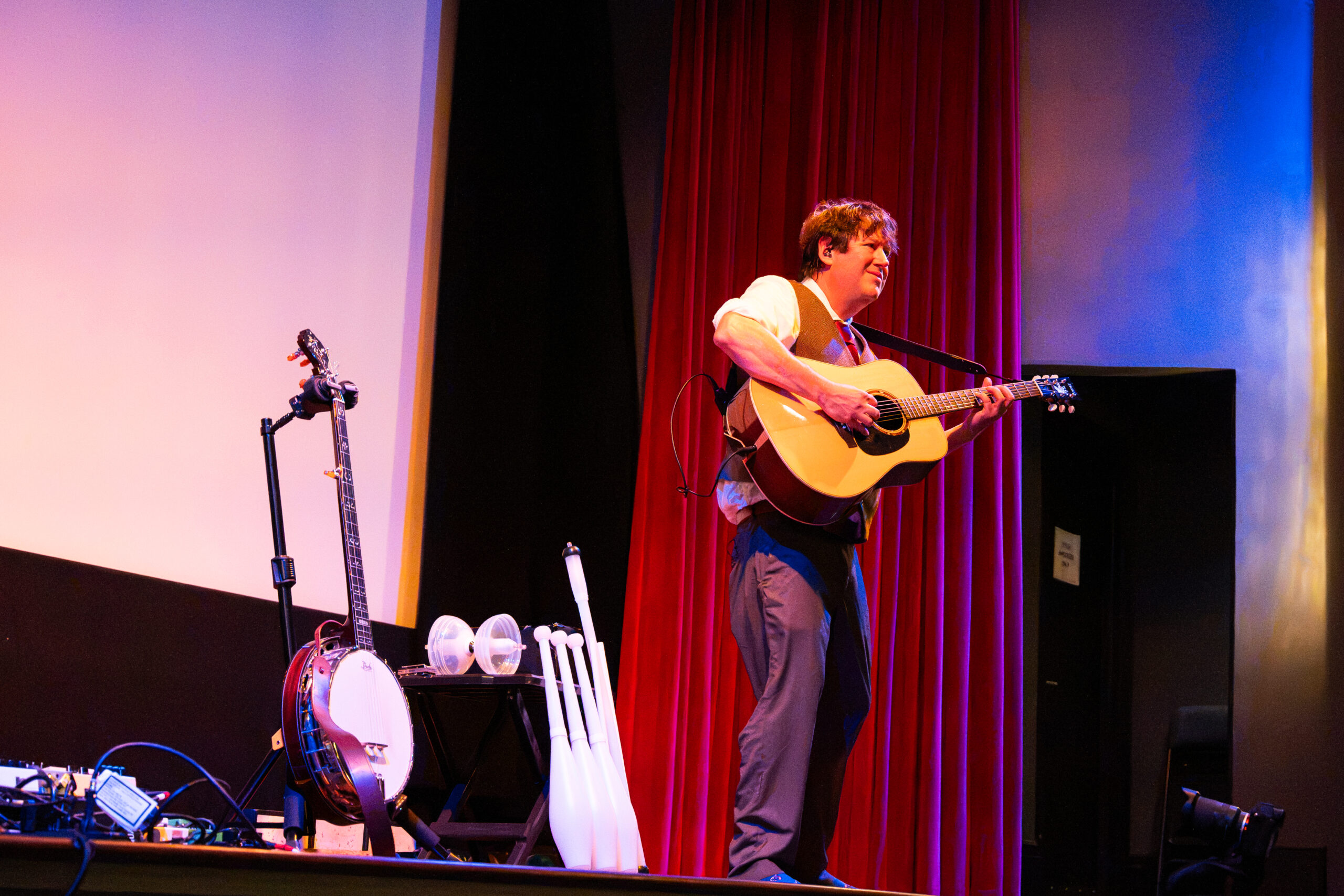
“More banjo!” the audience shouted at Brian Tomaszewski’s Friday night Banjo and Juggling Vaudeville show at The Little Theatre, part of the ESL Rochester Fringe Festival.
His show throws in everything but the kitchen sink. On stage, he had a guitar, a harmonica, an Irish whistle, a blowing horn, an electronic percussion pad, two banjos, a mess of foot pedals to loop sounds, and a collection of juggling apparatuses.
In this one-man show, he takes each instrument, one by one, and loops and layers phrases so that he can juggle hands-free. Why not? It’s a fringe-worthy performance oddity.
With an interest in music from cultures worldwide, his songs draw on influences from places like Rwanda, China, Poland, Ireland, and even his hometown of Rochester, NY. His versions may lack authenticity—except for the music of his cultural background, Poland; the Poles in the audience seemed more than pleased, adding in syncopated “hajs” to the well-known Polish song—but the admiration is there.
More impressively, Tomaszewski is a professor at RIT in the Interactive Games and Media department. He’s a geographic information scientist, which explains his interest in sounds from around the world. And this show feels like the kind of zany side gig a brainy professor might pursue.
—Anna Reguero






Be First to Comment