
In the operetta Candide, the characters are trying to stay alive in the face of misfortune and calamity. This is especially so for the titular character, the impressionable Candide, whose name plays on the word ‘candid.’ Indoctrinated by his tutor Dr. Pangloss, Candide naively wades through disaster after disaster across countries and cultures in a kind of Carmen Sandiego geographical chase, reciting the famous phrase of eighteenth-century Leibnizian optimism: that he’s living in the “best of all possible worlds.”
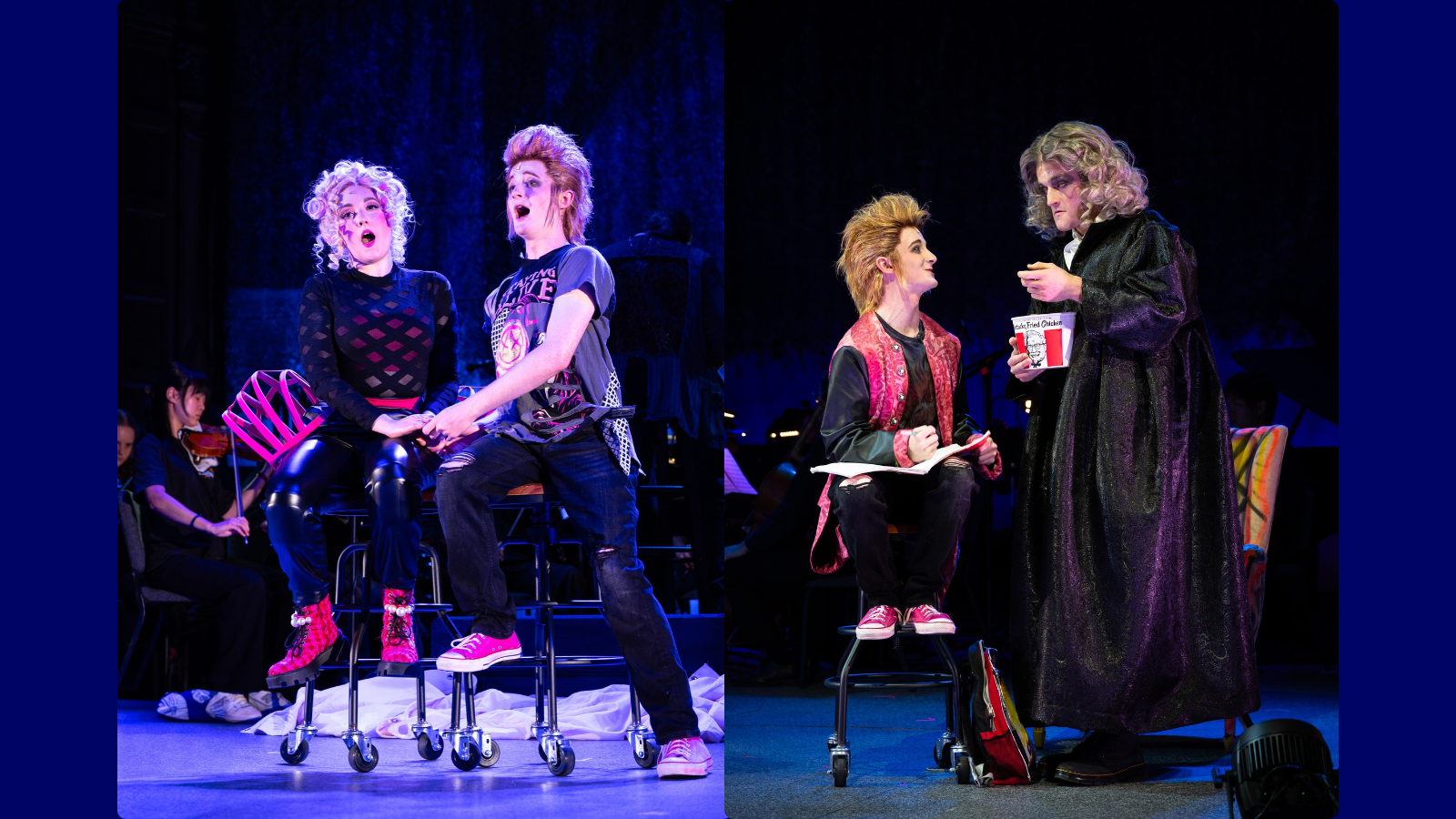
But in the Eastman Opera Theatre’s current production of Leonard Bernstein’s Candide, directed by Pat Diamond with musical direction by Timothy Long, reality is displayed right on Candide’s shirt.
Candide at one point wears a graphic T-shirt with the Bee Gees’s lyrics “Stayin’ Alive.” It carries several significations. The literal one, of course, is that Candide is trying to survive war, famine, flogging, shipwrecks, and more while desperately clinging to Dr. Pangloss’s optimistic teachings. But those who know disco as a counterculture movement will also see it as reflective of the operetta’s messaging. The operetta adapts Voltaire’s satirical novel Candide, an eighteenth-century work that exposed a popular strain of philosophy that dismissed empiricism in favor of rationalizing God’s greatness. Candide was pointed counterculture literature in its day. Voltaire couldn’t ignore reality in his writing, and by the end of the operetta, neither can Candide, who is searching for his personal discothèque, a haven from both tragedy and philosophical dogmatism where he can simply be with the object of his affections, Cunegonde.
The T-shirt is one of many striking costume choices in the production, influenced by 1970s British punk fashion designer Vivienne Westwood. Leather and distressed materials, garments with asymmetrical cuts, holes and cutouts in fabric, all with neon or other colorful accents against metallics and blacks, are worn throughout the production’s cast. Spiked hair, chunky combat boots, and exaggerated makeup help complete the look. It’s a fun look, and the student cast seems to embrace the spectacle of rebellion. But Westwood is an inspired choice because her garments deconstruct elements of royal dress, with clear connections to the Enlightenment aristocracy of Voltaire’s time, while communicating the operetta’s anti-establishment intention.
One example is the pink coat-dress worn by Cunegonde, the Baroness’s daughter who falls in love with and plans to marry the illegitimate Candide before he’s banished from Westphalia due to his social standing. Her dress hangs over an exaggerated, caged side-hip pannier—evidence of her nobility, emphasized by her platinum, curly powdered wig. But it’s complicated by punk-influenced perforations and pink-patterned Doc Martens, and even her blonde powdered wig is accented with pink locks. When the invading Bulgarian army attacks her home and whisks her away from noble comforts, she loses the coat-dress, revealing the pink hooped cage underneath, which Cunegonde can’t seem to discard for much of the rest of the production. Her nobility is a construction, but she can’t shed it, and its severe shape gets in her way as she, too, tries to cling to optimism despite enduring abuse from her captors.
As Eastman’s smaller, fall production, EOT performs Candide’s Chelsea version: a condensed, fast-paced production that premiered in 1973 at the Brooklyn Academy of Music. It featured a reworked book by Hugh Wheeler, with some added lyrics by Stephen Sondheim, that dispensed with some of the more overt political messages of the 1956 original Broadway version in favor of a streamlined plot emphasizing high humor. A chamber version, several singers juggle multiple character roles, a practical way to reduce the cast size while creating opportunities for comedic recognition.
It’s a high-octane production that never stops moving, even shifting some action offstage and into the aisles, a defining feature of the Chelsea production from the ‘70s that Diamond, the director, was able to recreate in Kilbourn Hall. And Kilbourn Hall’s intimacy also creates an immediacy between stage and audience that’s missed in larger productions. But with all the jet-setting (well, sailing) across exotic countries, it can be hard to follow the plot’s passages, if not for the outline readily available in the program.
Eastman’s production, however, hammed up the staging, adding several hilarious touches. There was a bucket of Kentucky Fried Chicken passed around, conductor Timothy Long—conducting the student chamber orchestra on stage, set back as far as possible on Kilbourn Hall’s limited real estate—helping himself to some of the twice-stolen loot, a shipwrecked Candide dogpaddling across the center aisle, and two sheep in the utopian city of Eldorado blissfully happy and high with a bong, who then stash and must remove the bong from a jewel box in a later plot shift.
The Thursday night student cast—who will reprise their roles on Saturday evening—fully inhabited their characters and embraced the comedy. Their good time on stage translated into easy comedic timing and effective entertainment. Diamond’s background in theater, rather than purely in opera, was clearly an asset in helping students embrace the work’s drama as actors, not just singers.
There were several standout performers. Lucas Mann was a boyish Candide in stature and expression, like a merry jester. Yet his voice drew me into the character, with ringing clarity and effortless phrasing that conveyed as much of Candide’s ideological purity and naivety as his acting. Sofia Mains was a fitting counterpart as Cunegonde, striking poses and looks that convincingly communicated her character’s strengths, cleverness, and vulnerabilities. Her rendition of “Glitter and Be Gay,” where she slowly decorates herself with jewelry and grows increasingly indignant about succumbing to two men who take advantage of her and silence her with shiny gifts, was gripping theater as she conquered the song’s challenging vocal runs and leaps. Elijah Gebers, who doubled as Dr. Pangloss and Voltaire, was an especially persuasive philosophical puppet master, drolly acting the role with an underlying sinister touch to his teachings.
The musicians, led with cool confidence by Long, supported the singers well. A smaller ensemble than I’m used to hearing play the overture, I did miss some of the lushness a bigger string section can bring to Bernstein’s score, but it proved advantageous when the orchestra didn’t overpower the singers. Memorable moments included the dissonant accents from the brass and clarinets that emerged from the busy stage texture, and when clarinetist Harrison Kim was recruited for a fateful boat ride as he smoothly intoned under the Old Woman’s storytelling.
For all the production’s entertainment value, however, its silliness often overshadowed the plot’s violence. Death, rape, hangings, natural disasters; all were treated in the production cavalierly and jokingly rather than shockingly. Some of that is in the script and lyrics, but some seemed like deliberate choices to make the story more palatable to a general audience. In doing so, it also limited the political currents that could be extracted from the work. I imagine a production that could better connect blind faith in certain major politicians with our country’s increasing economic strains and international conflicts.
But the production delivers one political payoff at the end. When the ideological mask is torn off Dr. Pangloss, who can’t answer simple questions about the point of his philosophy, Candide and Cunegonde resolve to do what they can independently of the world’s troubles and grow and cultivate a garden. In the Chelsea version of Candide, even that small attempt at peace and security is interrupted by cows that spread a pox over the land, and the operetta ends with the ensemble looking up at the heavens and then keeling over on stage.
Diamond took it one step further: he had the cast pull out medical masks as they fell to illness, invoking the Covid-19 pandemic that shook our sense of well-being and security in 2020. That small act was a concluding lightning bolt that jolted recognition with our times, and perhaps one that might have Voltaire smiling down on the production.
Remaining performances are Saturday at 7:30 p.m. and Sunday at 2:30 p.m. in Kilbourn Hall. Tickets are $20 each and can be purchased online at the Eastman Theatre Box Office.
Featured Photos by Jay Kline.
Disclosure Statement: Author Anna Reguero maintains freelance contracts with departments within the Eastman School of Music.




Be First to Comment