
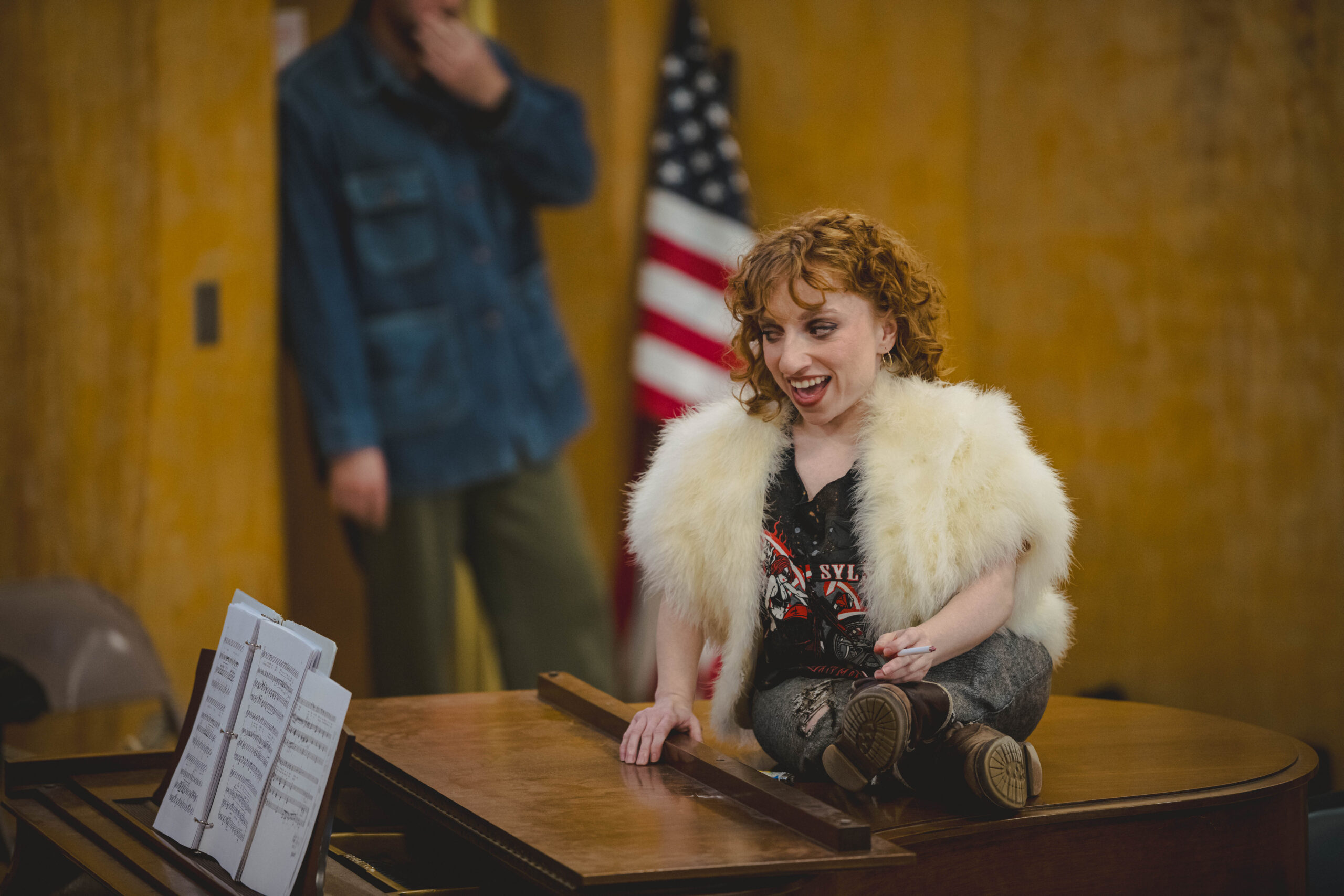
Gangsters and religious missionaries sound like opposing crowds. But in Happy End, the Kurt Weill, Bertold Brecht, and Elisabeth Hauptmann musical theater work from 1929, they are far more alike. They are both wayward groups fighting capitalist injustices, albeit from opposing vantage points, and they both struggle to hold onto their moral imperatives, ultimately floundering in their missions. The likeness of the two groups at the center of Happy End was highlighted in the production presented by Finger Lakes Opera on Thursday, July 25.
The set for Bill’s Beer Hall, the gangsters’ enclave, and the Salvation Army missionary headquarters were nearly identical sides of the set panels, aside from the liquor. And the vintage factory clothes barely differentiated the groups, with only red cardigans signaling the Salvation Army members.
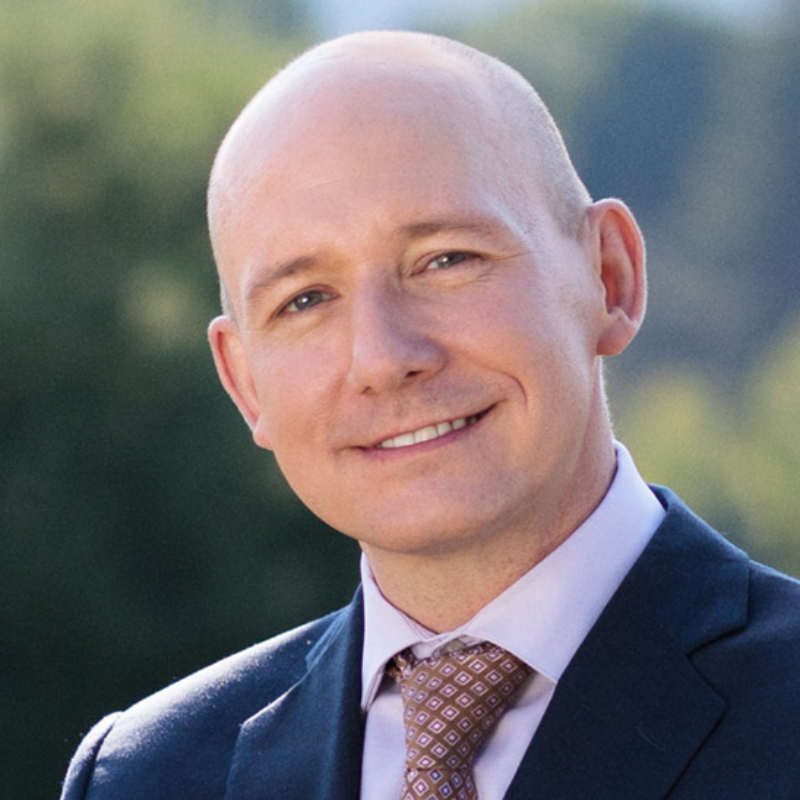
The production was part of a multi-company collaboration between Finger Lakes Opera and the Glimmerglass Festival, Opera Saratoga, and the Seagle Festival. It was directed by Opera Saratoga’s Mary Birnbaum. Glimmerglass Artistic and General Director Rob Ainsley played double-duty as the production’s musical director, while also inhabiting the role of the show’s Inspector, who plays the ‘hall’ piano, providing accompaniment for the singers. Happy End made stops at the Seagle Festival and Opera Saratoga in May.
The production makes a final summer stop at Glimmerglass in Cooperstown, NY this coming week, from July 28 to 31.
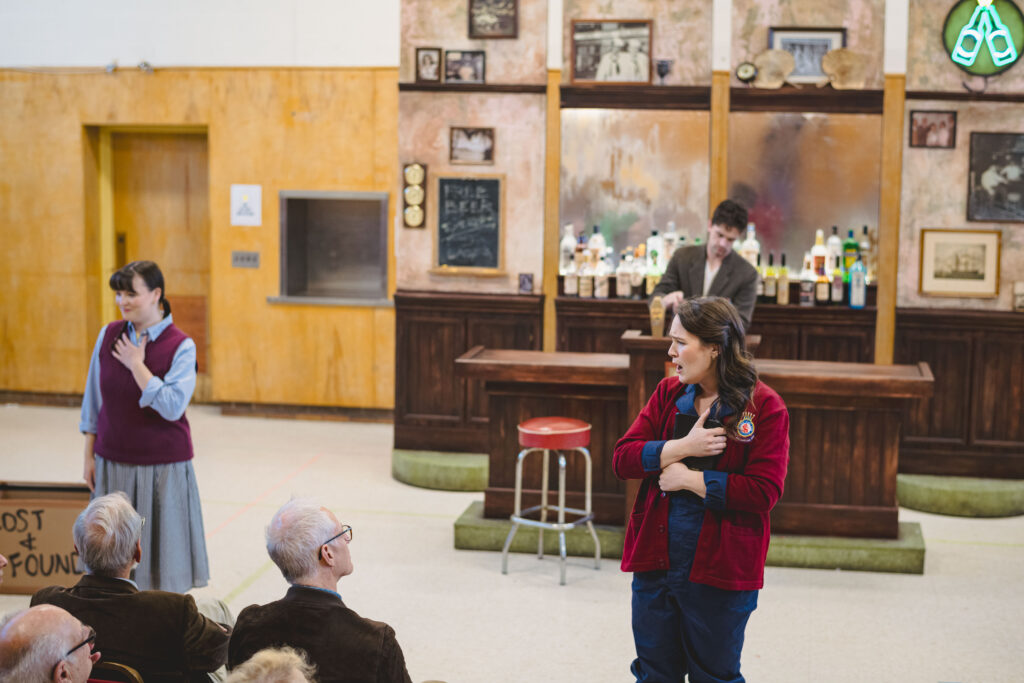
The semblance of the two groups was not simply a feature of the production; it’s part of the show’s strategy. In the show, the bar gangsters are attempting a major heist—ordered by a ringleader named The Fly—to steal a wad of cash, undeterred by the moralizing missionaries who target the gangsters with their latest conversion tactics. Salvation Army Lieutenant Lillian Holiday, however, has the gangsters’ main criminal, Bill, questioning his alliances, forcing her to question hers in turn. They become targets of their organizations while falling in love. All the while, the gangsters and the missionaries comedically hobnob. The show’s outwardly kooky, slapstick qualities provide a popular casing for political commentary, satirizing both gang violence and religious dogmatism, as well as the ethical compromises that the populist must make for economic survival. It all resolves for—as the title suggests—a happy end. But not without a satirical number that calls for the likes of John D. Rockefeller, Henry Ford, and J.P. Morgan to save them (“Hosiannah Rockefeller”).
The original 1929 production went even further with the political messages for the final act, inciting the audience to riot. It took until the 1970s for the work, a follow-up to The Threepenny Opera, to return, as a Broadway production.
Those politics were downplayed in this production, which featured a newly condensed book by Kelley Rourke. With some setup and background stripped down, the antics of the gangsters and the mishaps resulting from the missionaries’ good intentions came to the fore. The new book also changed some of the plot details, resulting in a smaller role for characters such as the Governor, played by tenor Jonathan Pierce Rhodes, who FLO audiences might recognize as the lead from last year’s FLO production of The Anonymous Lover.
The comedy was heightened by the stage direction, which had the sidekicks of both sides—Benny and Jimmy, played by Jason Zacher and William Raskin, for the gangsters; and Hannibal and Maryjane, played by Bradley Bickhardt and Lauren Tory, for the missionaries—engaged in silly stagecraft. From on-stage flirting between the factions, gangsters in female lingerie, and characters running after each other in an old-fashioned chase sequence, the stage choreography, along with the cast’s synchronism, earned many laughs from the audience.
Other choices were funny but also engaged Brecht’s “defamiliarization” effects, actions meant to expose theatrical illusion and jolt the audience into socially engaged viewing. This included the timestamps of the heist held up on posterboard in deadpan by the absent gangster, the political messages on the back of the gangster’s vests (such as “Mothers Against CO2”), and the suitcase of cash that, on one side, instructs the audience to applaud.
Although this work functions as an ensemble work, the female leads were the standouts. Christine Taylor Price, as Lt. Holiday, garnered notice for her honey-hued voice but also for her engaged acting. Making her entrance down the center aisle of the Panara Theater at the Rochester Institute of Technology, she locked eyes with audience members, committed to her proselytizing. And she deftly acted the softening of her message as she was drawn to gangster Bill, and the defiance she felt toward the missionaries for abandoning her.

The night’s most memorable entrance, however, went to lead Ana Karenža, the Juilliard-trained, Slovenian singer and winner of the 2024 Kurt Weill Foundation’s Lotte Lenya Competition. She appeared first sitting behind the gangsters, revealed mid-song as the gangsters dispersed from in front of the bar. Only a fraction of the height of her castmates, the sight as she was revealed was especially gripping. And her acting and singing are diametrically opposed to her height. With racey curly hair and a leather jacket, she dominated the stage as The Fly, ordering around her gangster minions while zooming around on an electric scooter, and capturing the biting essence of Weill’s cabaret-like music—sung quasi-operatically—in the work’s famous tune, “Bilbao Song.”
This production adds to the Finger Lakes Opera’s two other mainstage productions this summer. One included Glory Denied, an opera about a veteran’s difficulty reintegrating following combat in the Vietnam War, which was performed on Sunday, July 19, directed by FLO Artistic Director Stephanie Havey. FLO worked with Rochester’s Veterans Outreach Center (VOC) on presenting the opera in a culturally sensitive way and invited Vietnam vets to see the production.
On August 6 and 9 in the Panara Theater, FLO presents its final opera of the season, another screwball comedy: Mozart’s Marriage of Figaro, also directed by Havey and conducted by Adam Turner, the artistic director and chief conductor of Virginia Opera. In the evergreen opera, the servant Figaro’s marriage is in peril due to Count Almaviva’s interest in Susanna, Figaro’s fiancée. A series of events that included mistaken identities ultimately unravel the Count’s plans. The opera is also known for its political layers, elevating servants as main characters who stand up to the upper class. FLO’s production will be traditional, but Havey says the size of the Panara Theater will allow for an unusual intimacy.
“There’s a lot of subtlety and nuance in how the characters relate, and because the audience is sitting close enough in this theater, they can see every expression and every smirk,” she says.
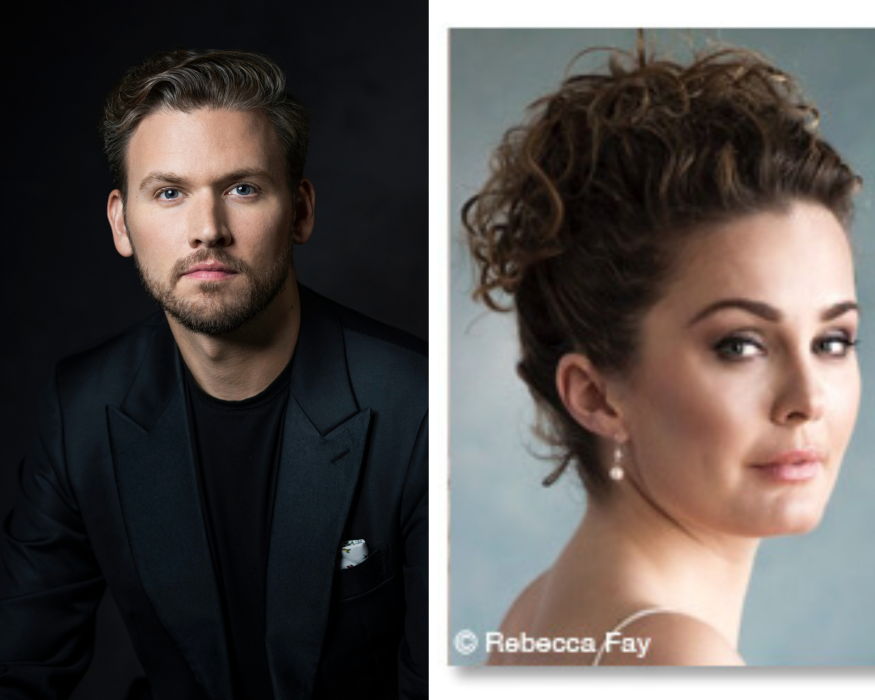
With the role of Figaro sung by Wm. Clay Thompson, a singer who came out of the Lyric Opera of Chicago’s training program, and Susanna sung by Ashley Emerson, who trained in the Metropolitan Opera’s Lindemann Young Artist Development Program and has now sung in hundreds of performances at the Met, Havey calls this her “dream cast.” The cast will be filled out with singers in the FLO’s Young Artist Program, which received 780 applicants from all over the world for this summer’s spots. Several of the young singers from past years have returned to star in FLO’s main productions.
Altogether, the summer’s three productions make up the largest season for FLO since its founding in 2012. It also adds to the outreach programs that FLO is becoming known for, which bring opera out into the community, from eldercare facilities to breweries. Next season, FLO will upgrade facilities by moving to RIT’s new Performing Arts Center.
—
The Finger Lakes Opera presents Mozart’s The Marriage of Figaro
Thursday, August 6 at 7 p.m. and Sunday, August 9 at 2 p.m.
Robert F. Panara Theater at RIT/NTID, 52 Lomb Memorial Dr.
Tickets are $68 to $96.
Featured photo: Brent DeLanoy





Be First to Comment