
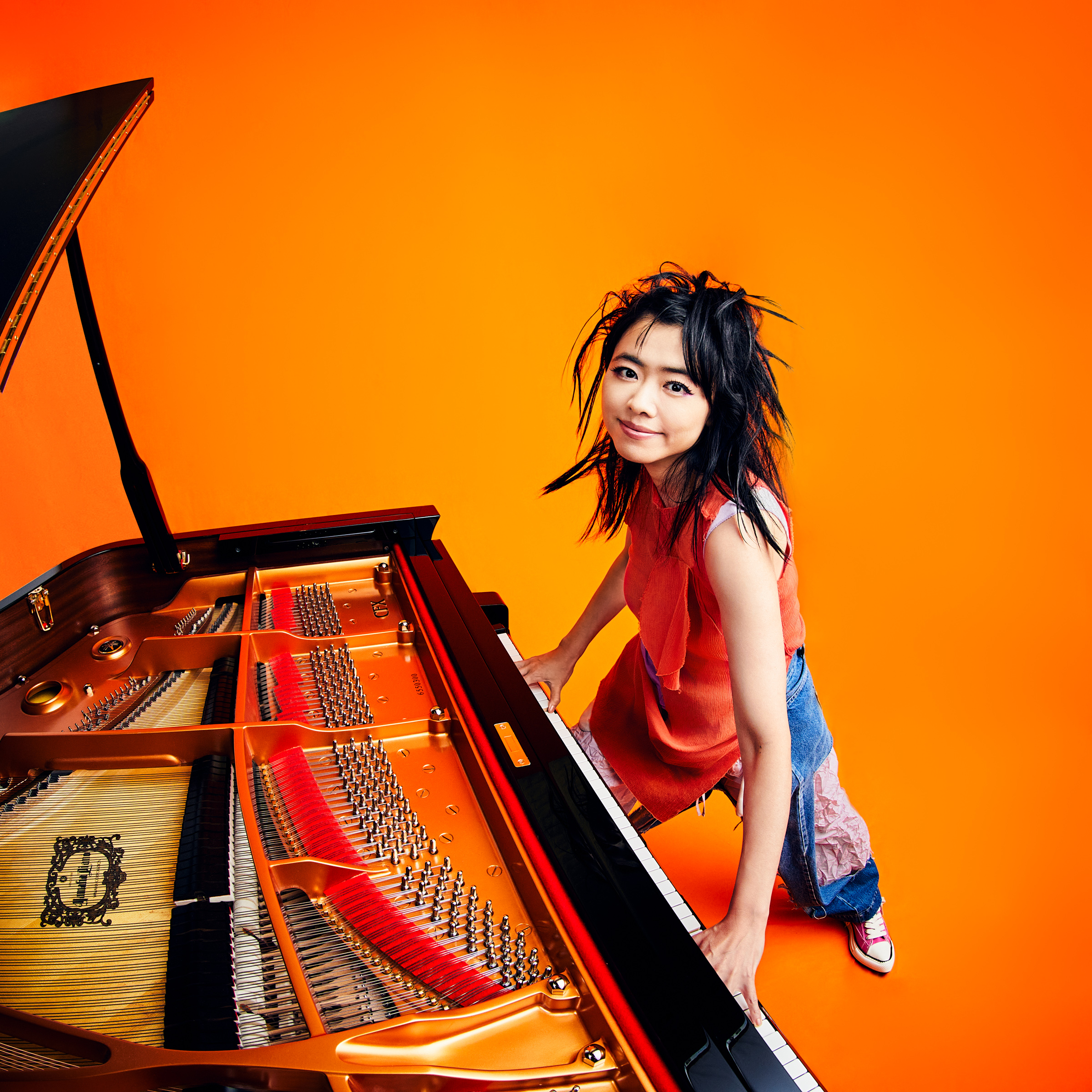
Not many musical artists can go by one name. Madonna. Prince. Cher. Even legendary jazz musicians like John Coltrane might have a nickname (Trane), but not a mononym. That should tell you a little something about the singular 47-year-old Japanese jazz pianist Hiromi. She has the tight rhythms of Chick Corea, the swing and stride of Oscar Peterson, the plugged-in funk of Herbie Hancock, the guts and dexterity of Toshiko Akiyoshi, and the showmanship and knack for a fashion statement of Yuja Wang. But cataloging the components of her musicianship is reductive for an artist like Hiromi, who is one of the most original voices in jazz today.
She credits her omnivorous musicmaking to a first piano teacher in her hometown of Hamamatsu, Japan. She was “the kind of person who listened to all kinds of music, from Bach to Jackson 5, Erroll Garner, Oscar Peterson, jazz piano trio stuff, and Bud Powell,” recalls Hiromi. “And she was introducing them without saying, ‘this is jazz, this is pop.’ She just said, ‘Ok, this is music, what do you like?’”
It was permission to open her ears and move beyond the classic jazz pianists she was drawn to in elementary school, towards rock music in her teens. Jeff Beck, The Who, and Frank Zappa led to the discovery of George Duke and Stanley Clarke, which naturally led to Return to Forever and the Headhunters. This was on top of an already full playlist of great jazz pianists like Corea, Hancock, and Keith Jarrett.
“Because jazz is a family tree,” she said in an interview earlier this month. “So once you discover an amazing musician, then you reach to other music. And that was a really beautiful part of discovering music. It was like a roadmap. It’s amazing, this jazz music jungle.”
But it was a chance meeting at a music school that sealed her fate as a jazz phenom. In the building where Hiromi, then 17, was taking piano lessons, the legendary Chick Corea was also practicing for a concert. She knocked on his door. He asked her to play. He started improvising with her. The next thing she knew, she was playing an encore at his concert the next night.
“It was just an eye-opening experience to be able to sit next to somebody whose imagination is that big, and whose knowledge is that big,” she remembers. “It was a fountain of ideas, fountains of music. And just to witness it right next to him, his hands right there, was just a magical experience.”
A decade after that first encounter—after Hiromi came to the United States to study at the Berklee College of Music—they were playing a duo concert at the Blue Note jazz club in Tokyo and recording together.
Hiromi likens Corea to a Jedi master. “He’s like Obi-Wan, and I’m like Padawan,” she jokes. “When I first met him, I couldn’t use any of the force. But 10 years later, I could use a little more. And a year later, when we recorded together, it was a little more.”
Playing with Corea was a yardstick for her as a student. But she considers being a student a lifelong pursuit. “That’s why I love Star Wars,” she says. “It’s just like the road to being a Jedi. I met all these amazing Jedi in history, like Anthony Jackson, Stanley Clarke, Simon Phillips, Chick Corea, and Wayne Shorter, Herbie Hancock. These are all master Yoda-level Jedi.”
Yet only a true Jedi could come up with a band like Sonicwonder. When Hiromi finds a sound she likes, the creativity just flows. That sound was the French bassist Hadrien Feraud, known for his pyrotechnics and penetrating groove. Feraud subbed in for Hiromi’s prior trio project, and Hiromi remembers the instant chemistry she felt. “I could really see where this chemistry could take us to. I started to really hear the music, having Hadrien’s bass in mind.”
Then it all came to her, the trumpet and drums. Seeking that sound out, she called on the genre-spanning drummer Gene Coye, known for his jazz fusion and hip-hop drumming, and trumpet player Adam O’Farrill, someone as skilled at improvising with the effects pedal as he was on his trumpet. And Hiromi? She expanded her sound, too, with synths. “Apart from Hadrien, I was writing the music and then looked for the musicians who could make what I heard in my head and realize it.”
Their debut album in 2023, Sonicwonderland (Hiromi’s 12th studio album), was a hard-grooving, arcade-animated, entrancing release that picked up the vintage jazz fusion of the ‘70s and ‘80s and plopped it into the present day. In April of 2025, they released their second album, Out There. This time, she already had the band, so she could write specifically for their collective strengths and sound.
The band’s freewheeling ease together comes through in tracks like “Yes, Ramen!” It combines the band’s wackiness with synths manipulated to sound almost like a traditional three-stringed Japanese shamisen. It wasn’t a deliberate attempt to weave in cultural sounds. It was just fun.
“I love ramen, I’ve been eating ramen all my life, and I happened to have a band who equally loved ramen,” she admits. “So I had to write for it.”
But her classical music roots also come through in the album’s title track, a four-movement, nearly 40-minute suite, “Out There.” The opening movement, “Takin’ Off,” has a metropolitan simmer, and an off-kilter funk comes out in the second movement, “Strollin’.” The third movement, “Orion,” is a sonic meditation, with Hiromi back on an acoustic piano, while the final movement, “The Quest,” is an upbeat descendant of Weather Report.
Hiromi, who will play with Sonicwonder in the cavernous but acoustically ideal Kodak Hall at Eastman Theatre on Tuesday, June 23 (7 and 9:30 p.m.), says she doesn’t pre-plan her sets; rather, she lets the venue dictate the music. “I always feel like the venue is performing with me,” she says.
While there are merits to bustling outdoor festivals and casual clubs, she says the concert hall can foster intense listening experiences. “I really love the level of focus,” she says of audiences in concert halls. “I enjoy the notes flying into the ear and each note having a soul and meaning, and they can hear every single detail. That is the beauty of the concert hall.”
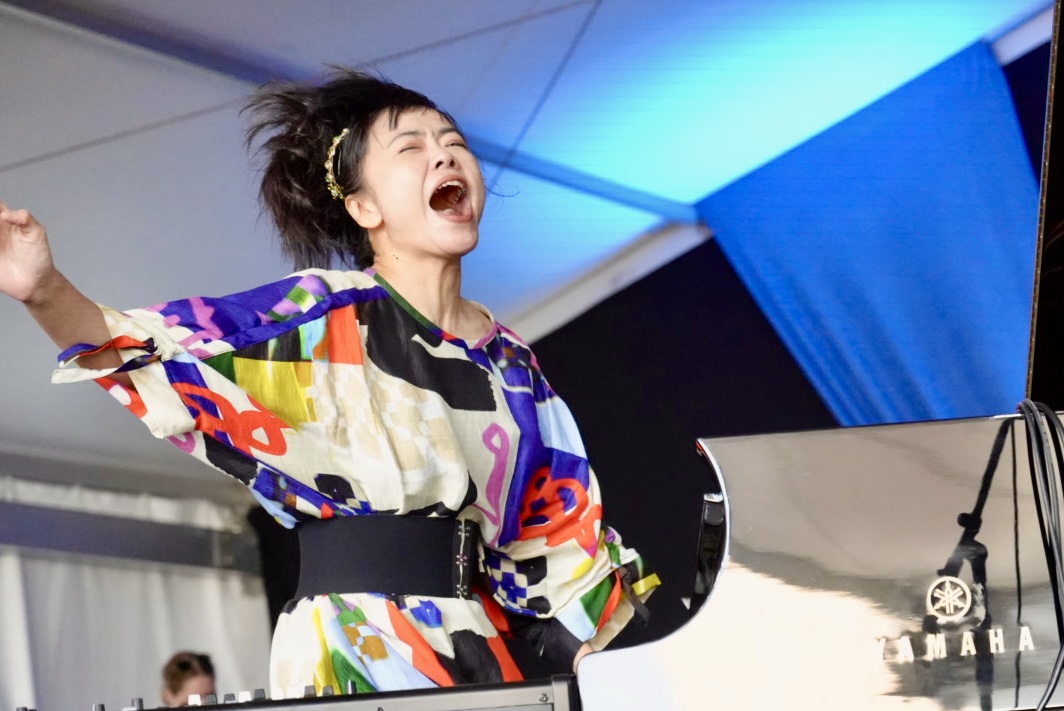
She’ll take time in soundcheck to get to know Kodak Hall’s acoustics and coax out the Steinway piano’s overtones, perhaps even saying some friendly words to the piano as they get acquainted. But when she plays, you can expect a full sensory experience, from the splash of notes she throws down, to the bodily thrashing that overtakes her, to the bold clothes she wears, to her distinctive spiked-up hairdo.
“I think it’s five senses,” she says of performances. “You just enjoy the music as an experience with all the senses you have.”
___
Hiromi’s Sonicwonder
Tuesday, June 23rd, 7 p.m. and 9:30 p.m.
Kodak Hall at Eastman Theatre
Club Pass or $40 at the door.
___
Featured photo: Mitsuru Nishimura
___
Make sure to follow Rochester Overture’s Field Notes for live Rochester International Jazz Festival updates and reviews.




[…] But this is serious play for Hiromi and she is a serious talent. According to Anna Reguero, who interviewed Hiromi, she was actually somewhat restrained on Tuesday. But “Yes, Ramen!” really cooked. Her […]