
In the middle of Aphex Twin’s “T69 Collapse,” a track off the Collapse EP released in 2018, the regular, if glitchy, dance atmosphere is suddenly cut into by abrasive mid-range synths. Chords tumble downward in a slow cascade of anxiety. Electronic beeps go haywire, falling like dropped bombs streaming through the sky. The beat feels bottomless and unpredictable, like craters. As SPIN put it, “When it falls apart, it sounds like the end of the world.”
But on Saturday night in Kodak Hall at Eastman Theatre, that moment of chaos took on a different dimension. It was as if an alarm had gone off.
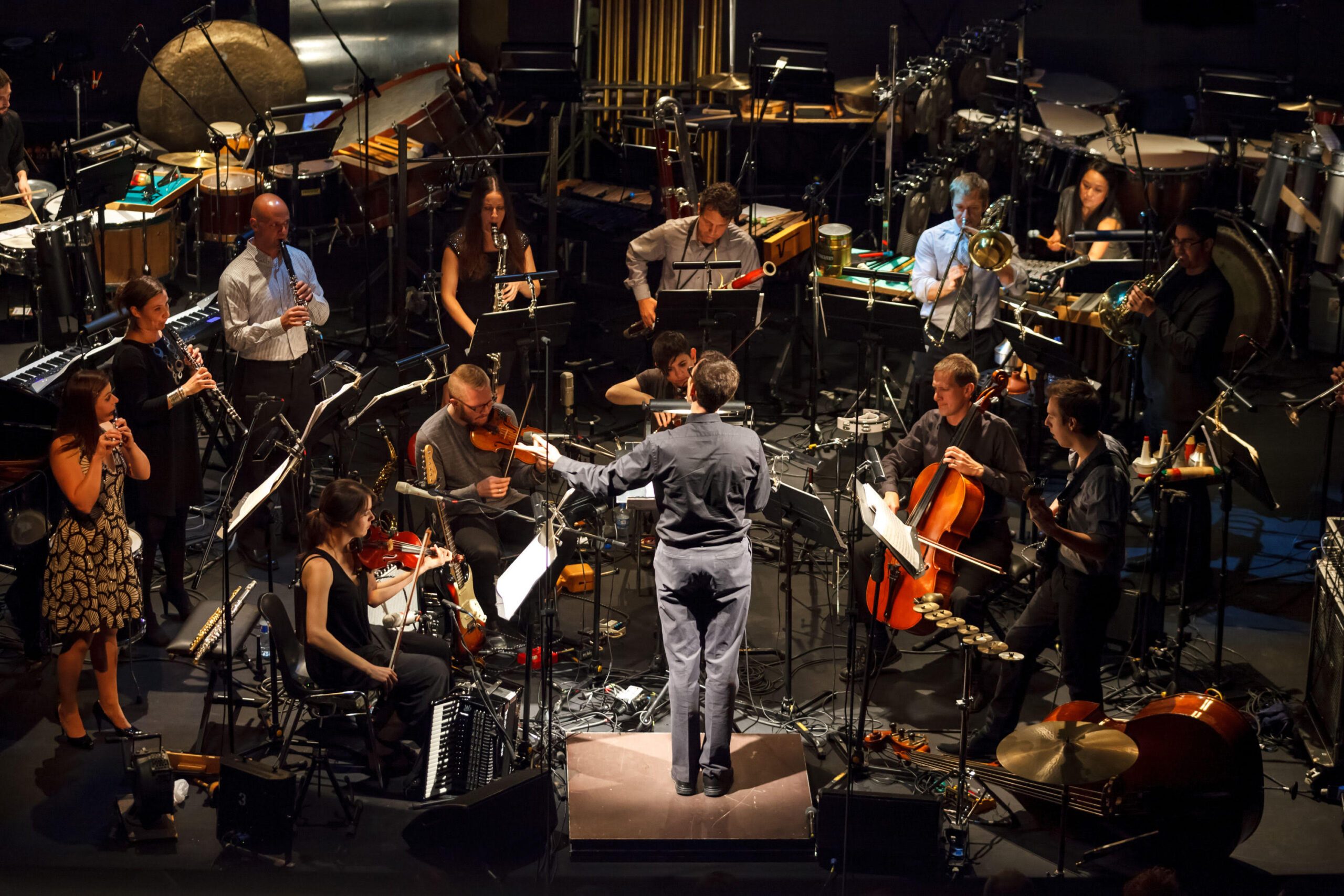
It was part of a concert by Alarm Will Sound (AWS), the successful contemporary chamber orchestra that formed at the Eastman School of Music 25 years ago. It all started in 1996 as a group of students who founded the student-run new music ensemble OSSIA; in 2001, OSSIA graduates formed Alarm Will Sound. The ensemble, which still features several Eastman alumni, returned to Rochester to perform during the University of Rochester’s Meliora Weekend.
The concert served as an early launch of the ensemble’s latest album, New Acoustica, which will be released on October 23. The project features acoustic arrangements of newer Aphex Twin songs and extends the acoustic translation concept to other popular electronic artists, including SOPHIE, as well as collaborations with electronic artists Jlin, King Britt, and Lucrecia Dalt.
It’s a follow-up to AWS’s 2005 debut album, Acoustica, in which the ensemble first transcribed popular electronic music for their acoustic classical ensemble, consisting of a small string section, winds, brass, piano, and percussion. Not only did it prove that highly trained musicians could successfully perform an acoustic version of complex, computer-generated rhythms and timbres in the concert hall, but it also emphasized that British electronic musician Richard D. James, the person behind the Aphex Twin moniker, created digitally produced music of artistic weight and compositional depth, challenging the high-low binaries between art and electronic music that were still prevalent in the aughts.
Acoustica mattered because a classical music ensemble was treating electronica—at least a sliver of it known as intellectual dance music (IDM)—as a serious source for musical inquiry.
But Acoustica came out over 20 years ago. No longer novel, the question on Saturday was: what more can be said about or extricated from the ensemble’s early experiment? It’s a fascinating time to be thinking about computer-generated sound versus sounds produced by visible human labor. Many of the electronic artists behind AWS’s selections seem to be making an argument for the post-human: the ability of computers to generate sounds humans cannot, or, in some cases, extend our abilities. In a 2026 context, AWS translating such posthuman sounds back into human bodies seems like a statement about the human endeavor to keep up with artificial worlds.
The only wrinkle is that the arrangements, while fascinating, can’t imitate the originals. When everything bottoms out and collapses in AWS’s “T69 Collapse,” the mid-range synth chords orchestrated for the clarinets, upper strings, and then oboe come across as dissonant chords, played vertically. It’s an alarm sounding but not some earth-shattering moment. Aphex Twin’s controlled pandemonium came off more like a mass of chaos.
AWS is an ensemble of incredible skill, able to make the complexities of sounds that seem out of human reach audible. But ask me which version I’d rather hear, and I’d probably pick the native source: Aphex Twin.
That’s not to say the attempts are not fun. SOPHIE’s “Faceshopping,” an industrial electronic pop tune about the ways we alter our appearance for approval, is an absolute joy to hear in a traditional concert hall, even if the instrumentation sounds a little more honkey-tonk than the hard-hitting metallic sounds of the original. It was a showcase for violinist Courtney Orlando, an Eastman alumna, who impresses as much with her radical vocals as she does with her exacting violin playing. It was also a percussion field day.
On Saturday, the experiment was most successful when the ensemble revived a tune from its original album, “Blue Calx.” The song is more ambient; it has spacey, morphing chords over a ticking and grooving dance beat. The acoustic instruments reproduce longer-held timbral and atmospheric shifts better than glitchy, mechanical electronics. The deep blue stage lighting added the right touch of theatricality.
The limitations of the acoustic-translation experiment were clear when AWS played, for an encore, “Dowland Remix,” a piece by Eastman alumnus and AWS pianist John Orfe. The ensemble starts off playing a measured, minor lament, the music of Renaissance composer John Dowland. But after the traditional intro, it snaps into a driving techno-influenced dance, then opens into a moment of sparkling, affective lyricism. Then, after the drums reset the atmosphere, it switches into avant-garde scratches before returning to its Renaissance source.
It’s the kind of piece that only an ensemble capable of Renaissance music, techno beats, and contemporary classical music could accomplish. Rather than arranging someone else’s electronica, the ensemble added elements of electronica to a new work in conversation with classical music’s long history. That’s the kind of sonic experiment that sits right in AWS’s wheelhouse, and the result was a virtuosic, assured performance—a showstopping ending.
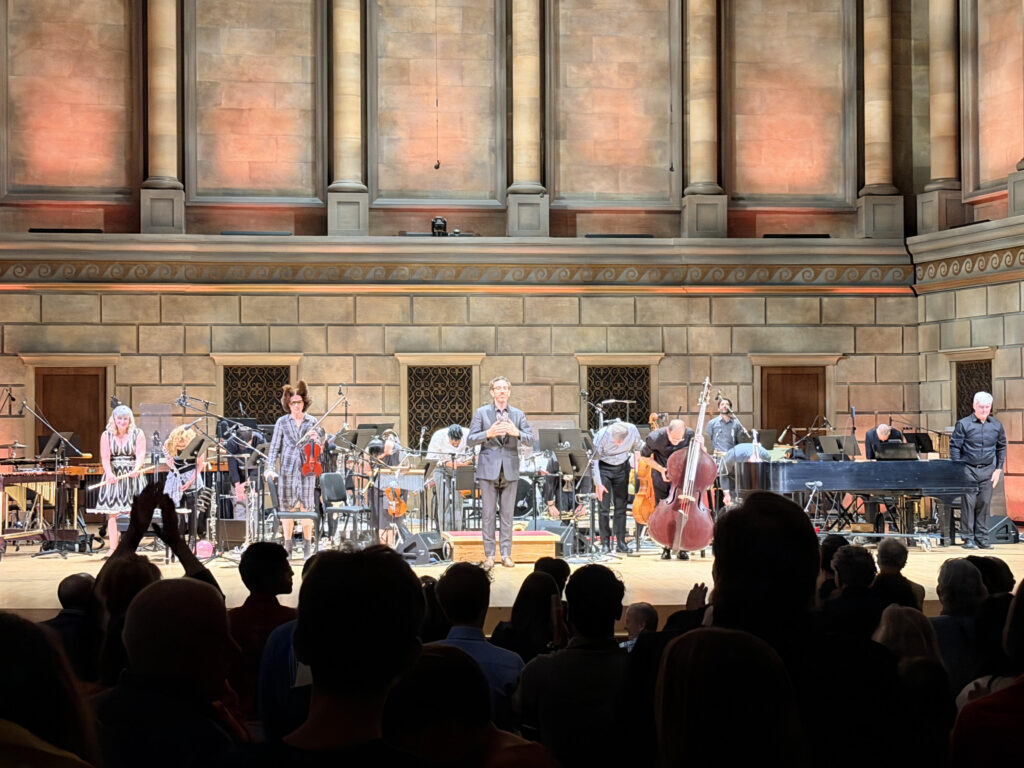
Nonetheless, New Acoustica can be heard as a look back at the ensemble’s early start 25 years ago and evidence of how it has expanded its early vision into the present. And there was much to learn from it for the several string students from the Eastman School of Music who joined on “The Intention,” a work arranged for AWS by its original creators, King Britt and Christopher Stark. AWS blends pure technical skill, adventurous extended techniques, and dramatic stage presence, with an overall attitude and aptitude for risk-taking.
The cavernous Kodak Hall didn’t help the electronic approximations find exactness despite the extensive mic hookups for the ensemble, so I’m looking forward to the produced recording. (Eastman eliminated the balcony seating for the show, which might have been a better place to take in the acoustics.) New Acoustica will be released on October 23 on Cantaloupe Records. You can pre-order the album for $10 on Bandcamp.
Also recently out is the AWS recording of composer Mary Kouyoumdjian’s Paper Pianos, created in collaboration with writer and artistic director of the University of Rochester International Theatre Program Nigel Maister. The work was a finalist for the 2024 Pulitzer Prize.
Featured photo: Wojciech Wandzel


Be First to Comment